

The Unicorn Tapestries
Exploring Two Famous Tapestry Cycles

(7 min read) This post looks in detail at two famous tapestry cycles, the “Hunt of the Unicorn” and “The Lady and the Unicorn” — on display in the Met Cloisters and Musee de Cluny, respectively.
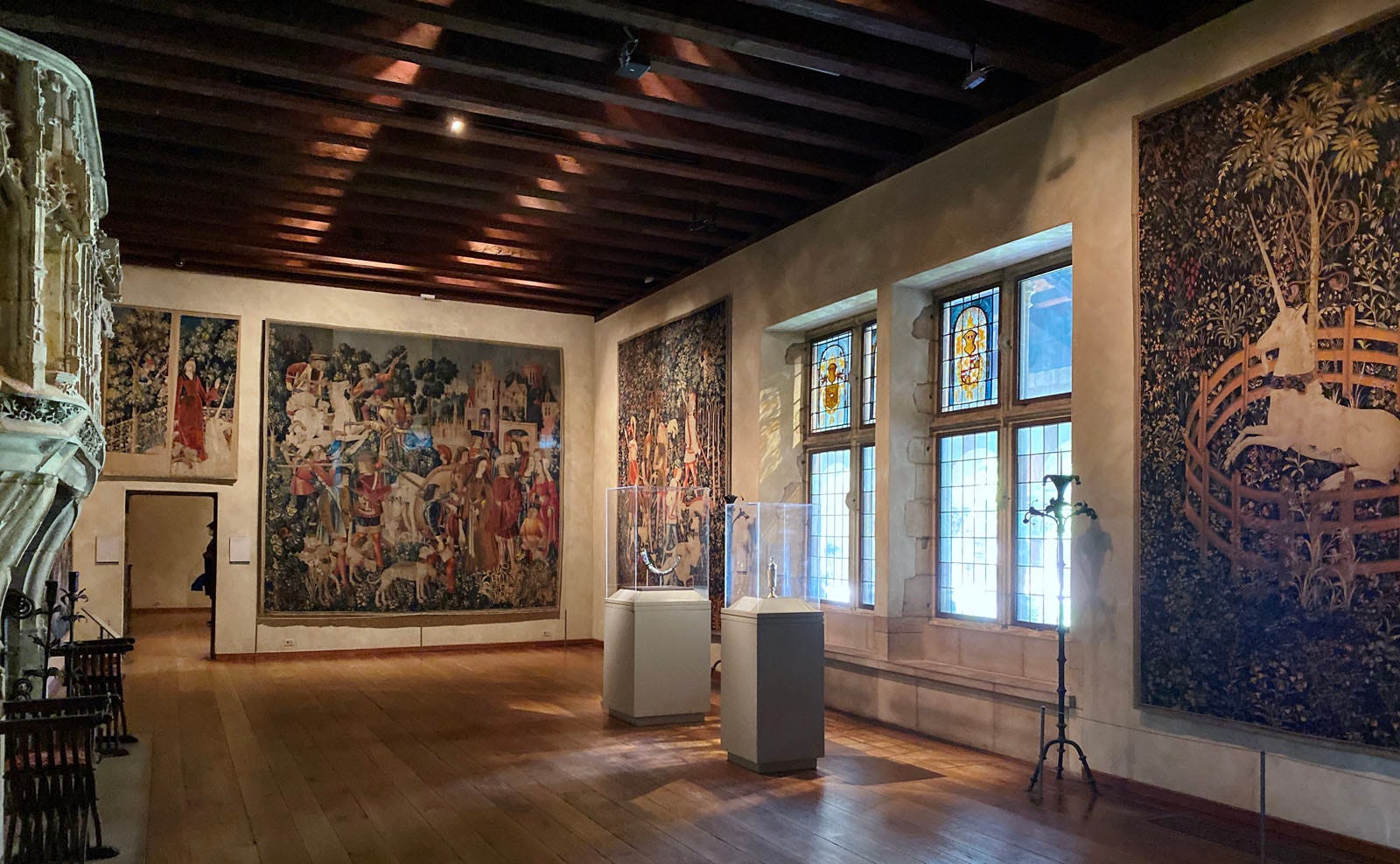
Last month I posted essays on “The Art of Medieval Tapestry” and “The Unicorn in Medieval Thought”. This post finishes off a little trilogy with those, exploring the two most famous tapestry cycles of the Middle Ages — the seven-tapestry “Hunt of the Unicorn” held at the Met Cloisters (NYC), and the six-tapestry “The Lady & the Unicorn” held at the Musee de Cluny (Paris).
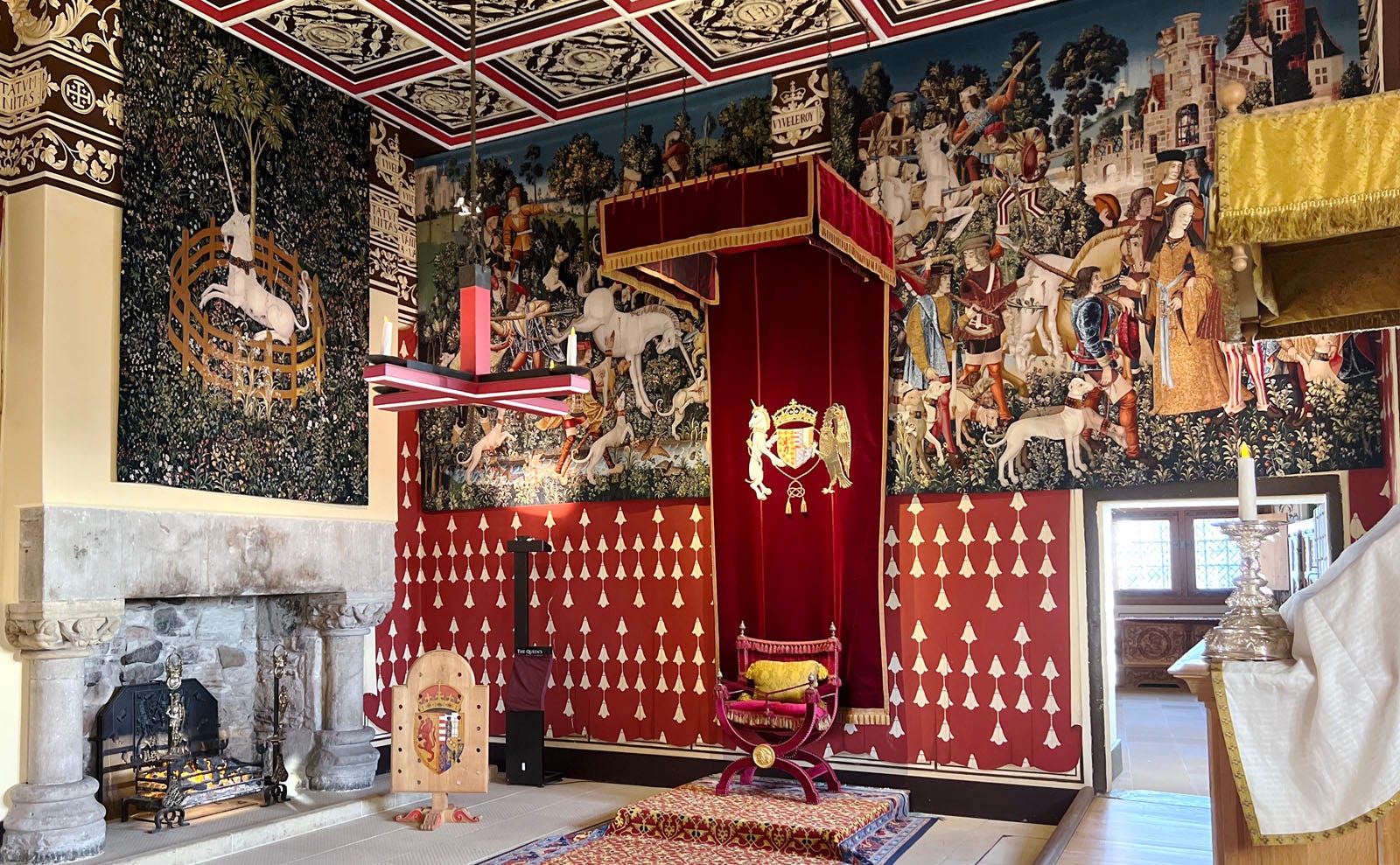
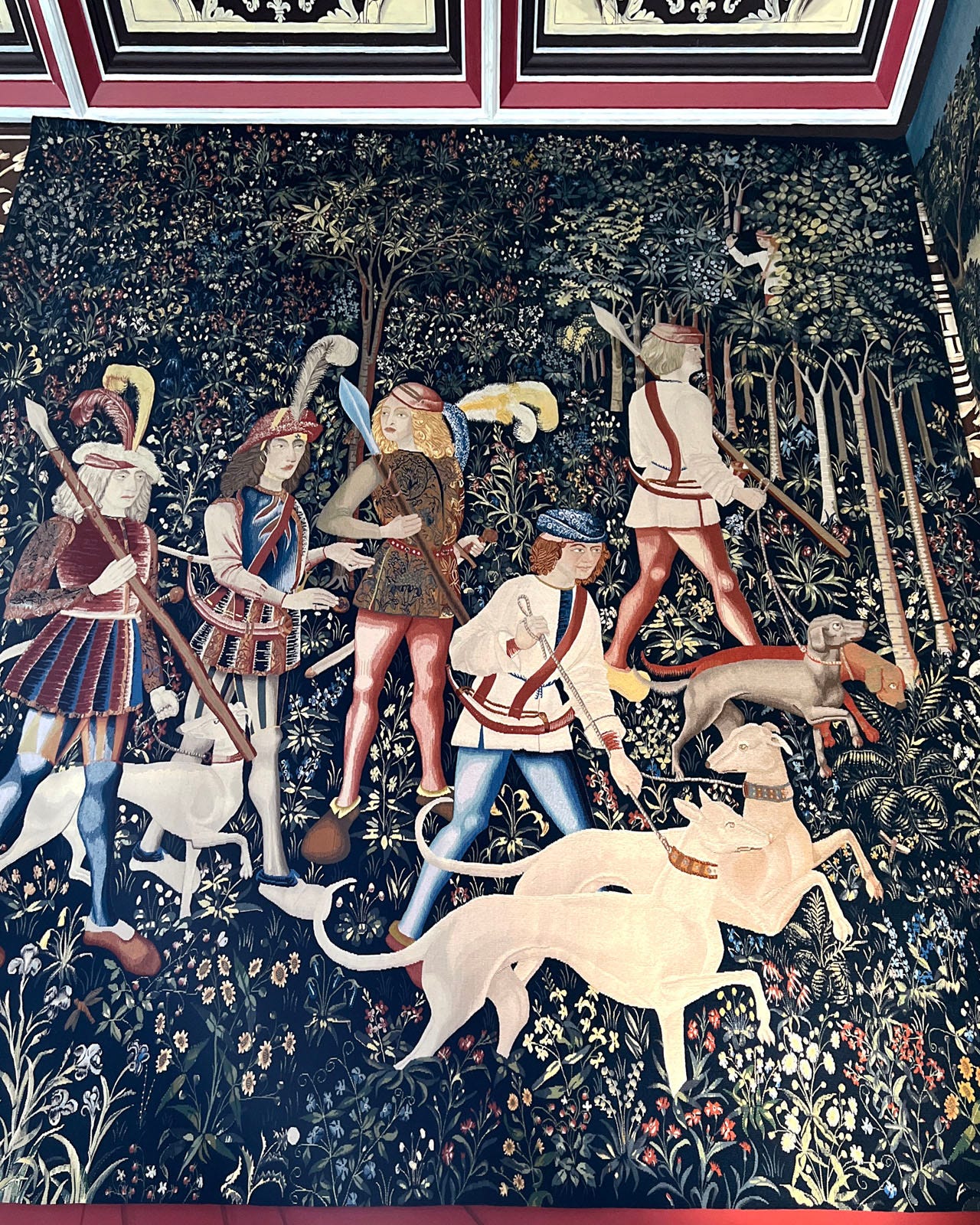
In addition, based on the theory that a similar set of unicorn tapestries once hung at Stirling Castle (recall from my unicorn essay that the Stuarts used the unicorn in their heraldry), a set of very high quality reproductions were created for it. Since 2015 these have hung in the queen’s quarters as part of a project to furnish the castle as it would have been in the 16th century.
In the below, I show photos of both the original and reproductions for the “Hunt for the Unicorn” cycle (figures 6-16), and the originals of “The Lady and the Unicorn” (figures 17-32).
These are all my photographs, and the low lighting in the Musee de Cluny — while understandable for preservation purposes — prevented my shots from showing the colors properly. While my detail photos provide some close-up views you will not find elsewhere, the Wikipedia page on “The Lady and the Unicorn” cycle has some great high resolution photos of each tapestry with brilliant colors. You may want to check those out as well.
The Stirling Castle Reproductions
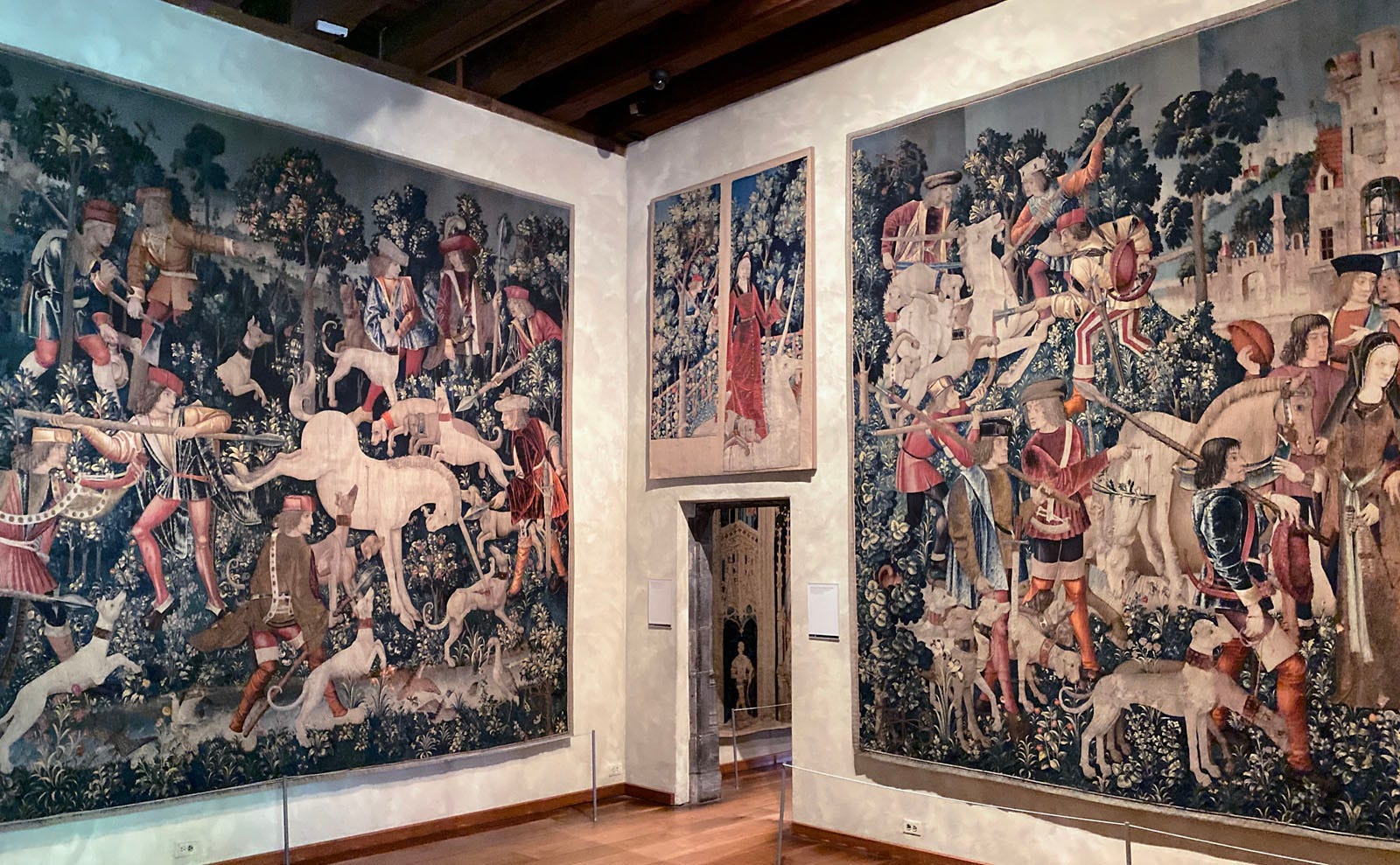
Having already visited the Met Cloisters, seeing the “Hunt for the Unicorn” tapestries in Stirling Castle (figure 1) was a big surprise to me, but I enjoyed the fact that they were displayed in a likely original context and that they did such an excellent job with the reproductions.
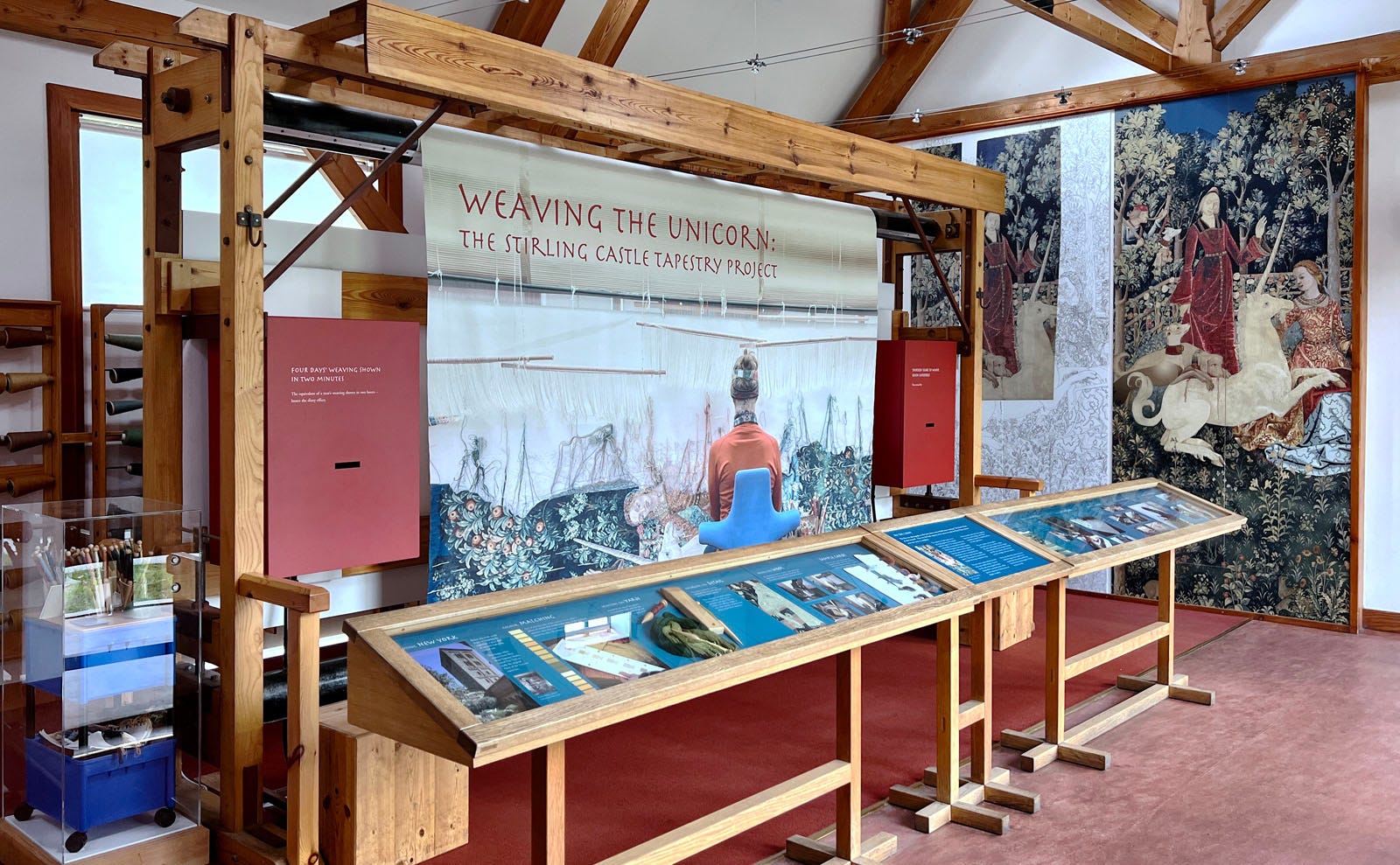
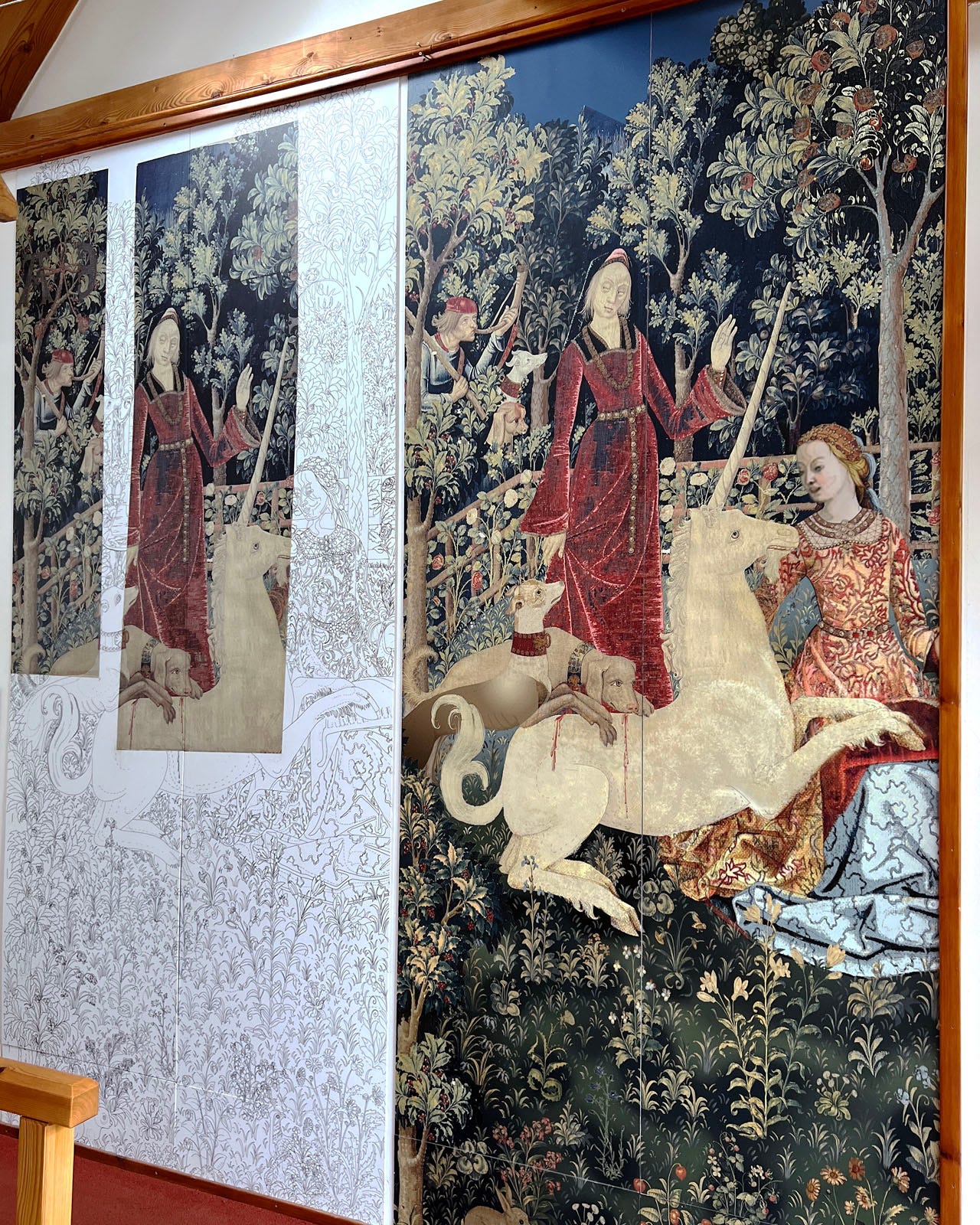
If you happen to visit the castle (and if you’re visiting Edinburgh, it’s a highly recommended day trip), seek out the galleries dedicated to showing the creation process (figures 3-5 & 11) — they’re housed in an old service building toward the back of the castle, near the kitchen if I recall correctly.
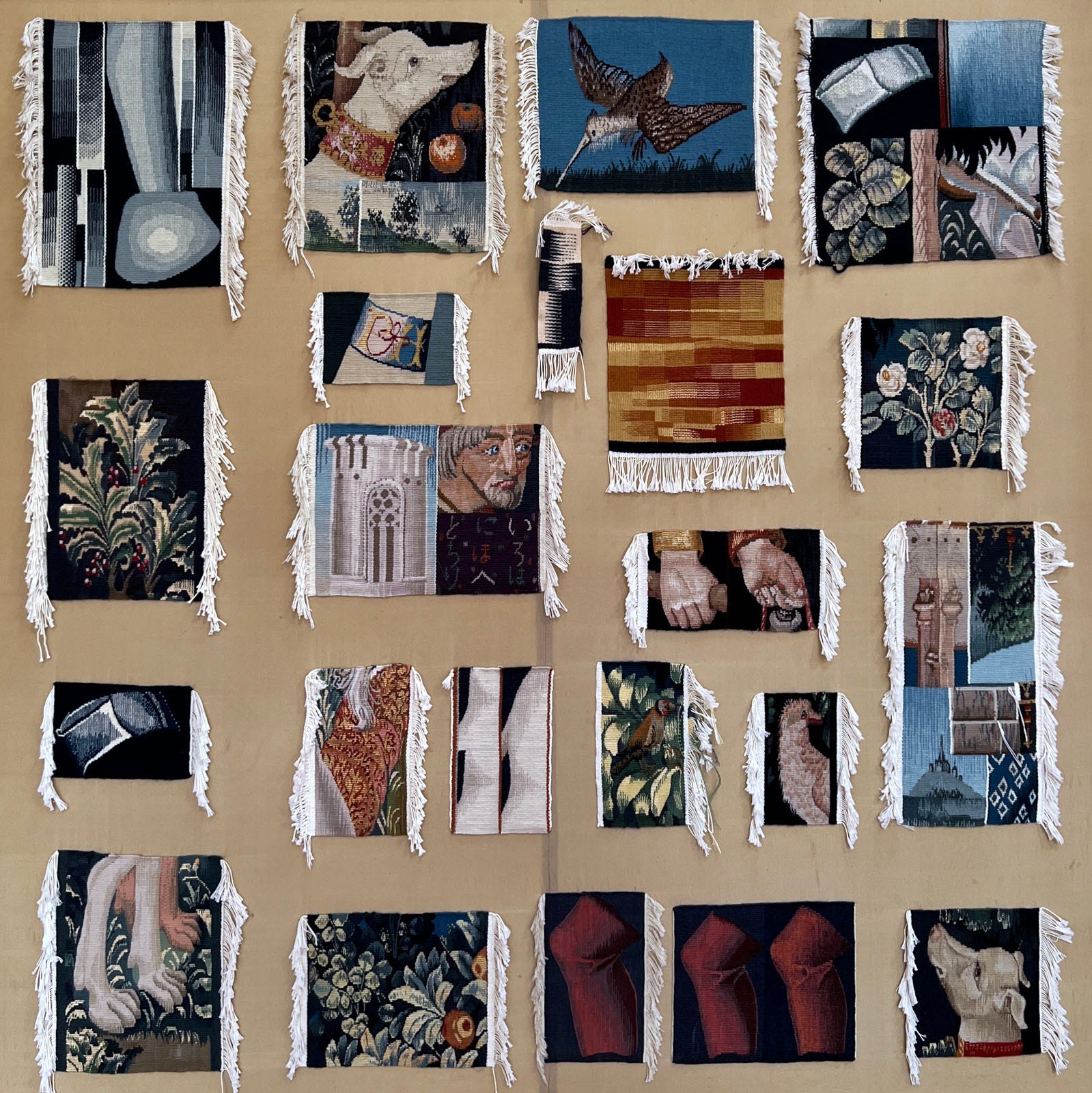
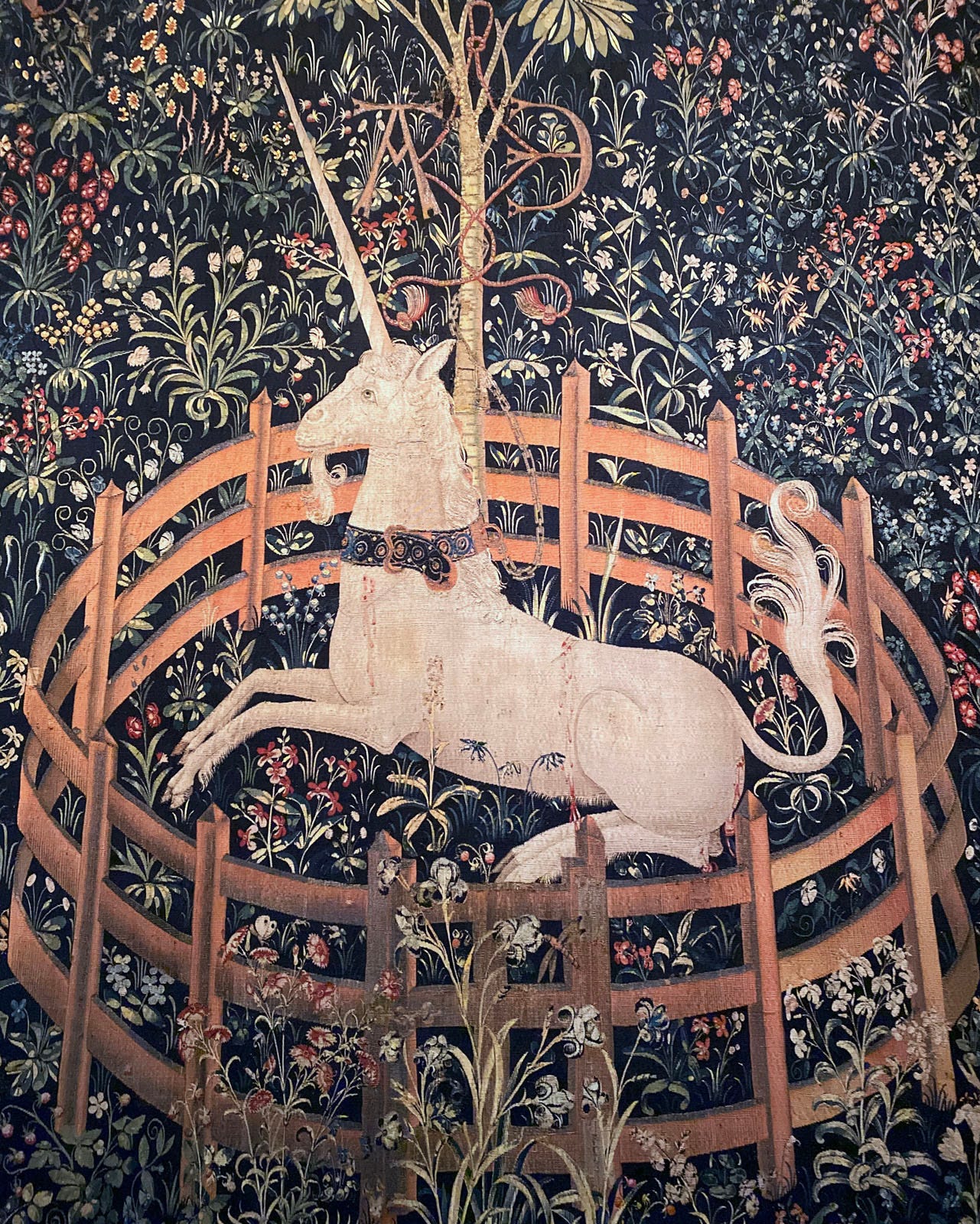
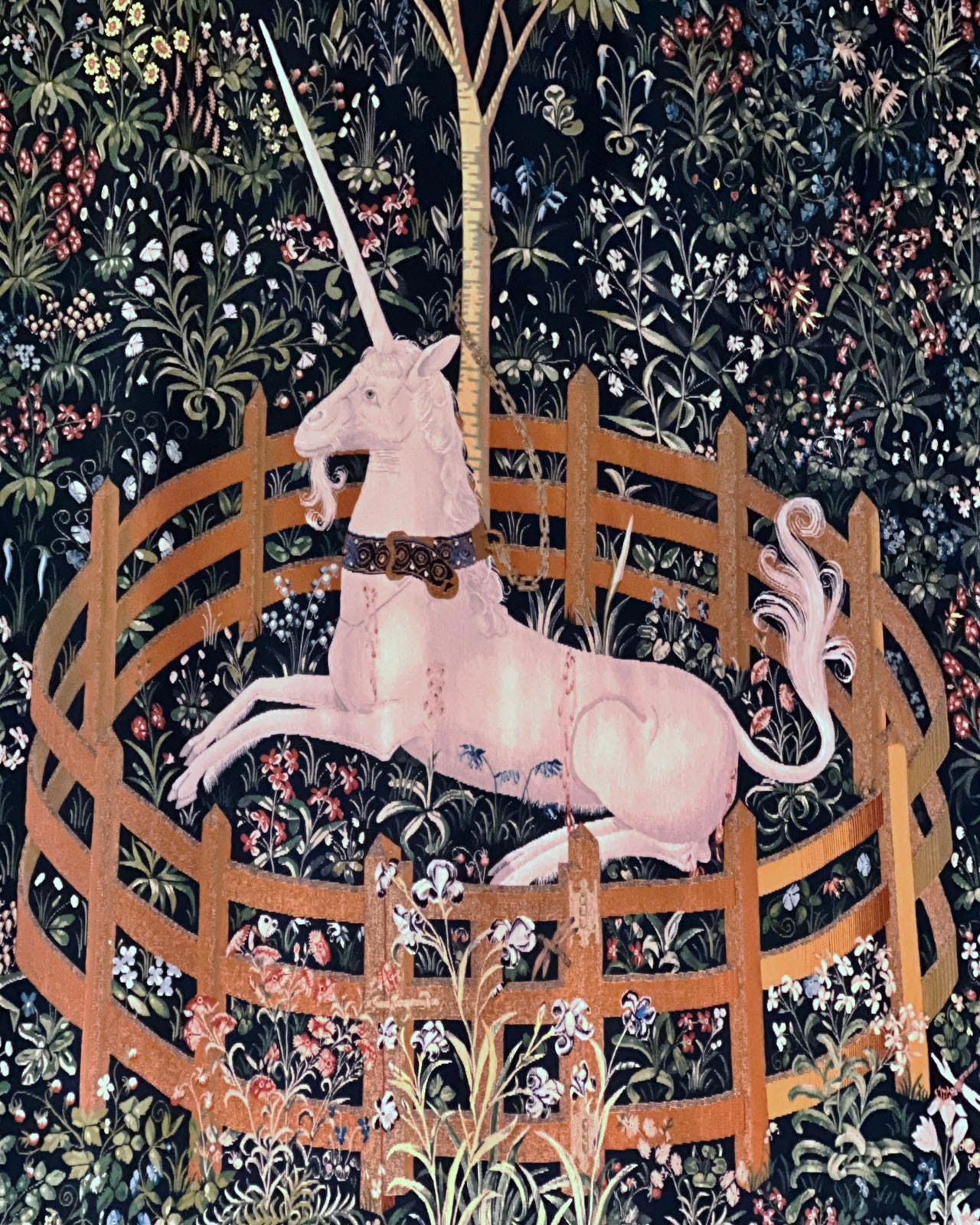
They worked hard to test colors and weaving patterns, as you can see in figure 4. And I have looked pretty closely at a few photos I have of both the originals and the reproductions, and except for (understandably) removing the “AE” monograms which were in the originals, they are darn accurate — figures 15 and 16 below show a comparison.
One major change they did make — though it will not come out in my photos and is not even really noticeable in person unless you get really close — is cut the thread count in half. Figure 4 shows example swatches using the original eight warps per centimeter and the reproductions’ four warps per centimeter. You can see the difference in the photo, but you would need to be very close to the tapestries themselves, comparing them side-by-side, to see the difference.
“Hunt of the Unicorn”
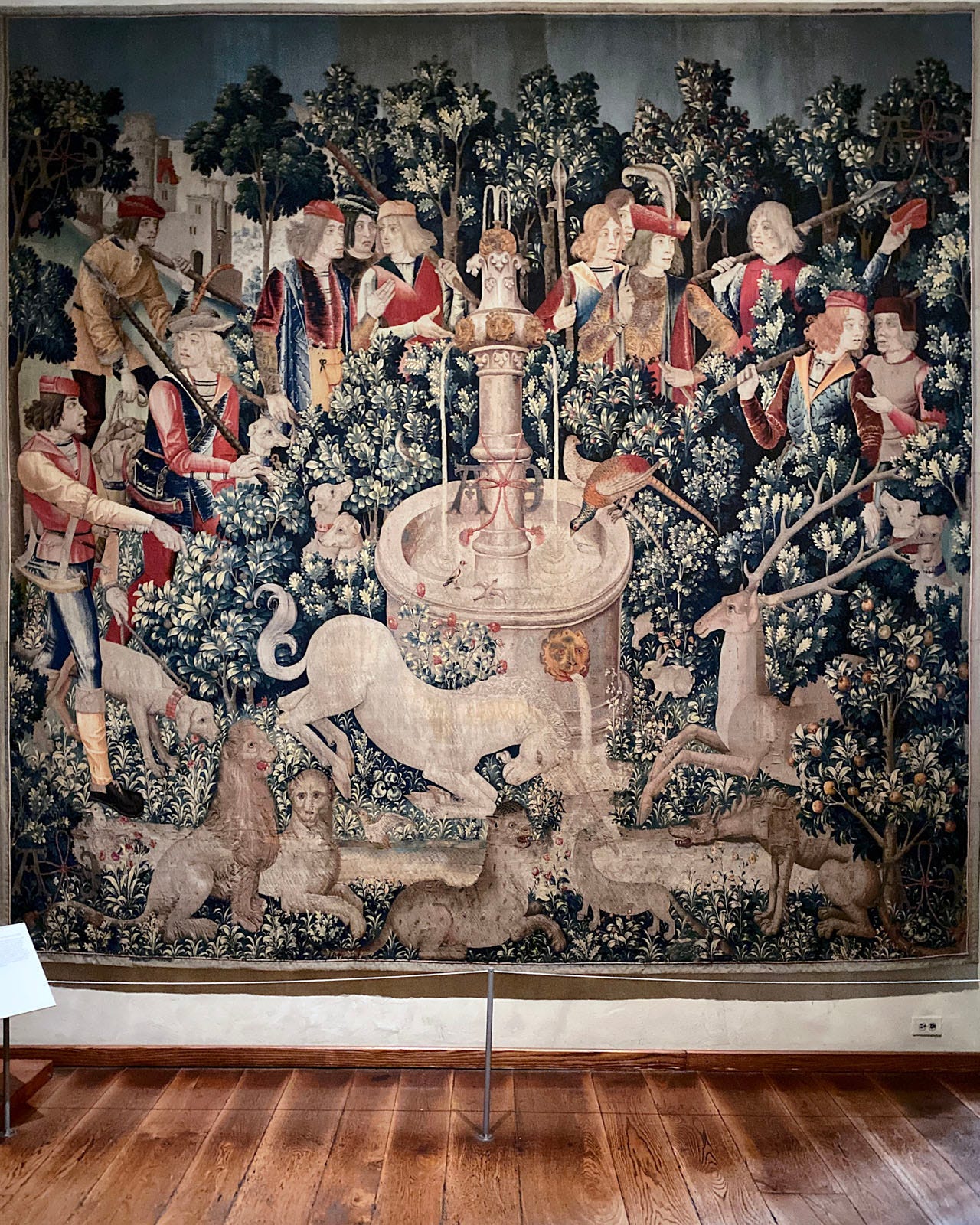
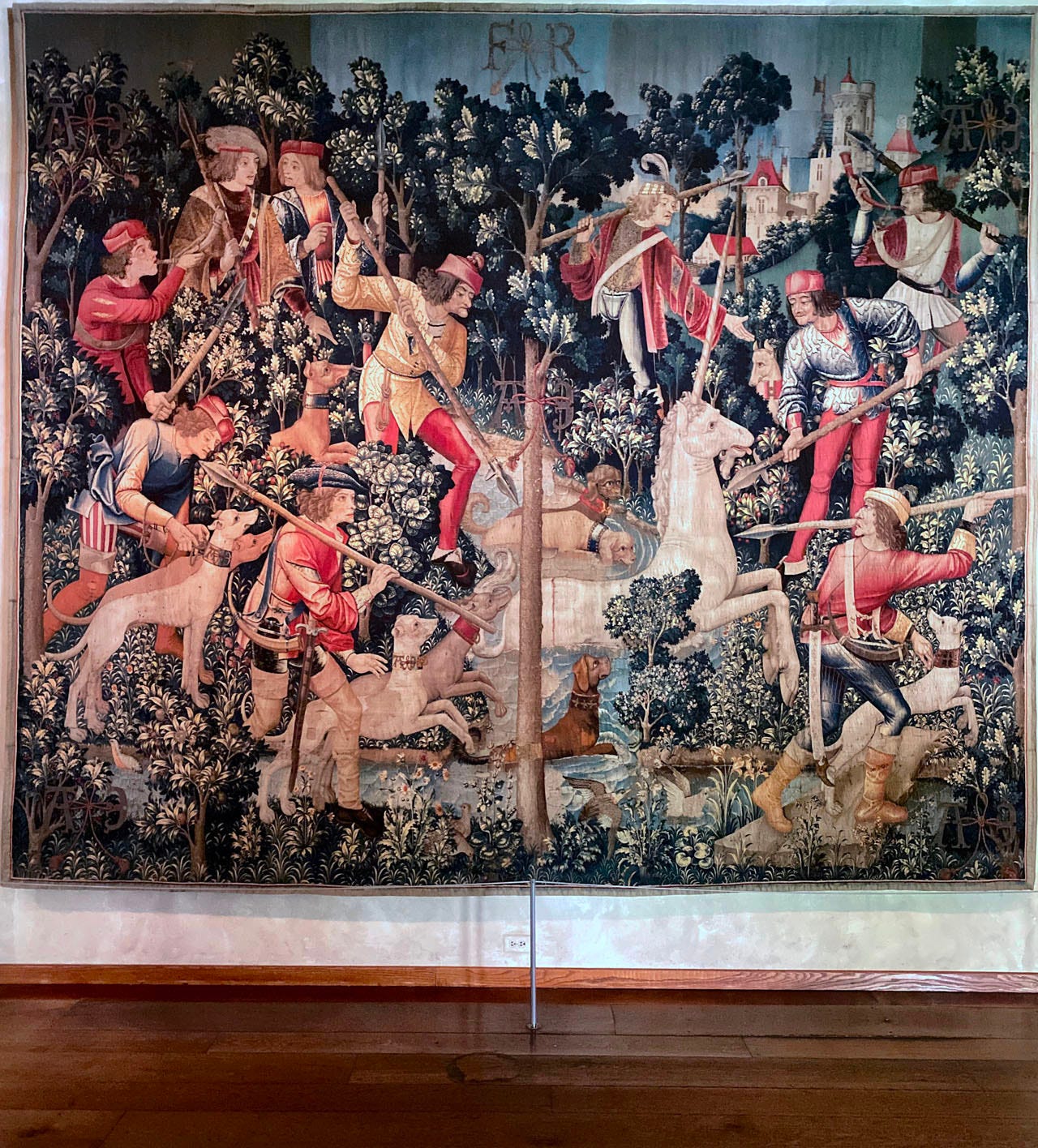
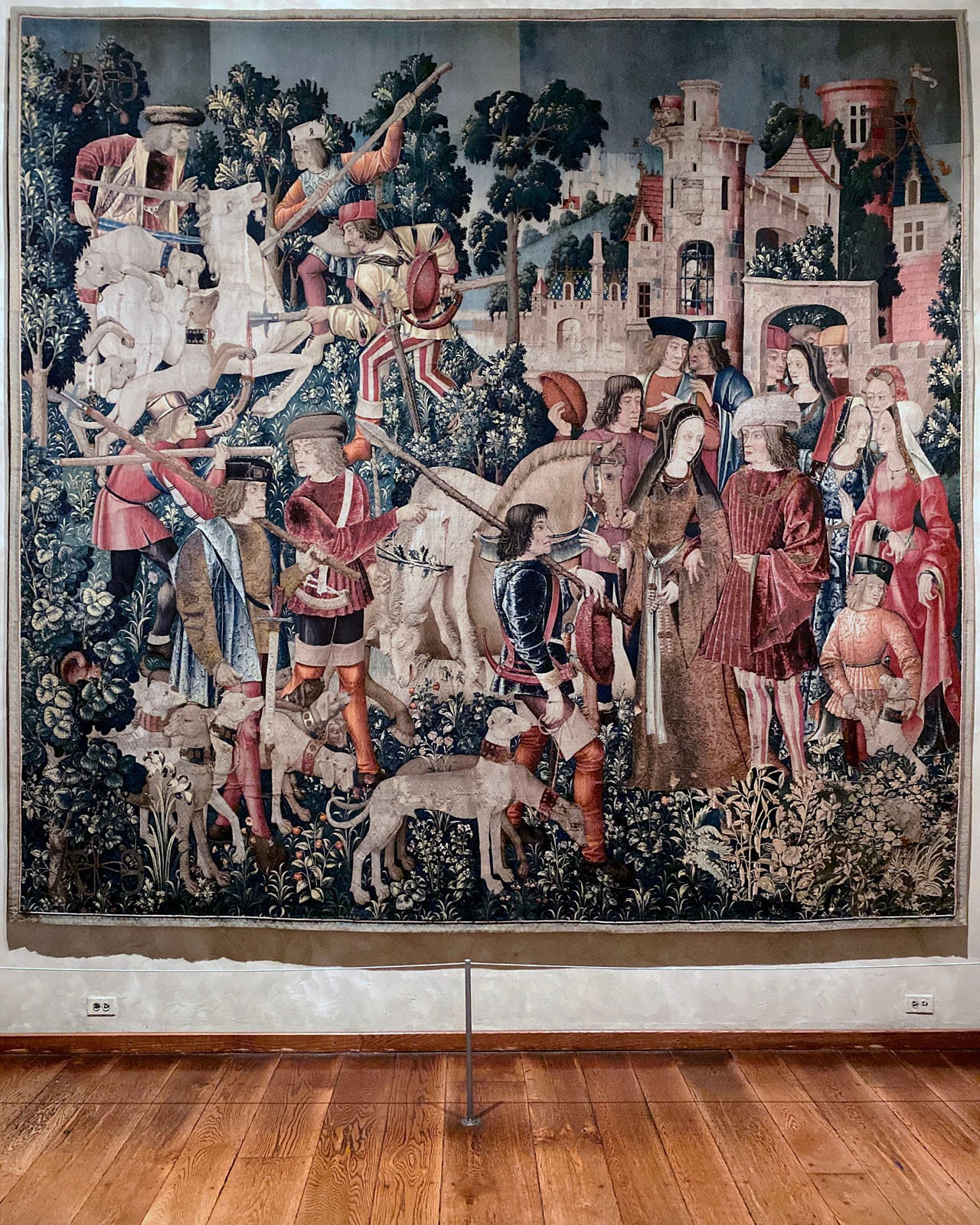
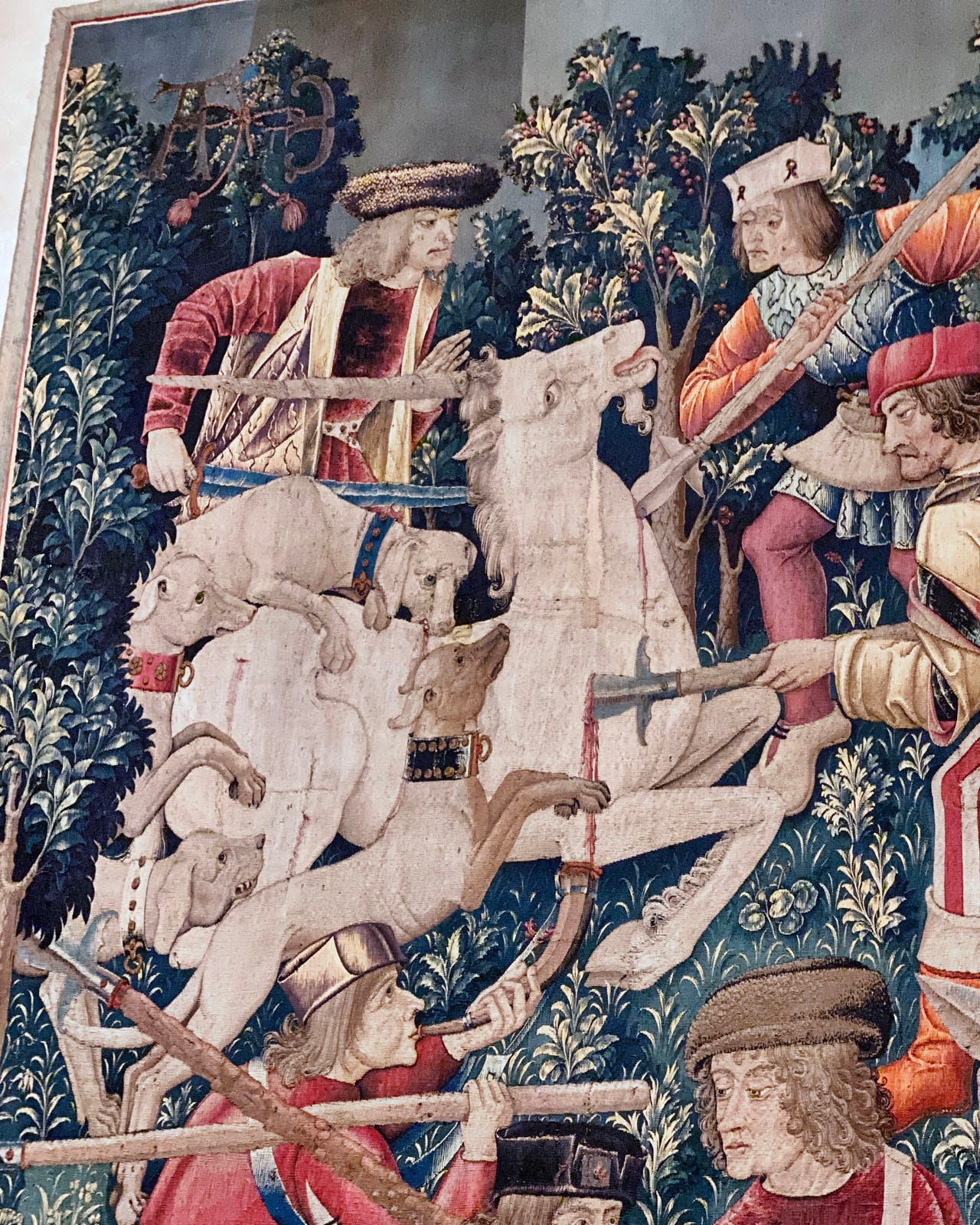
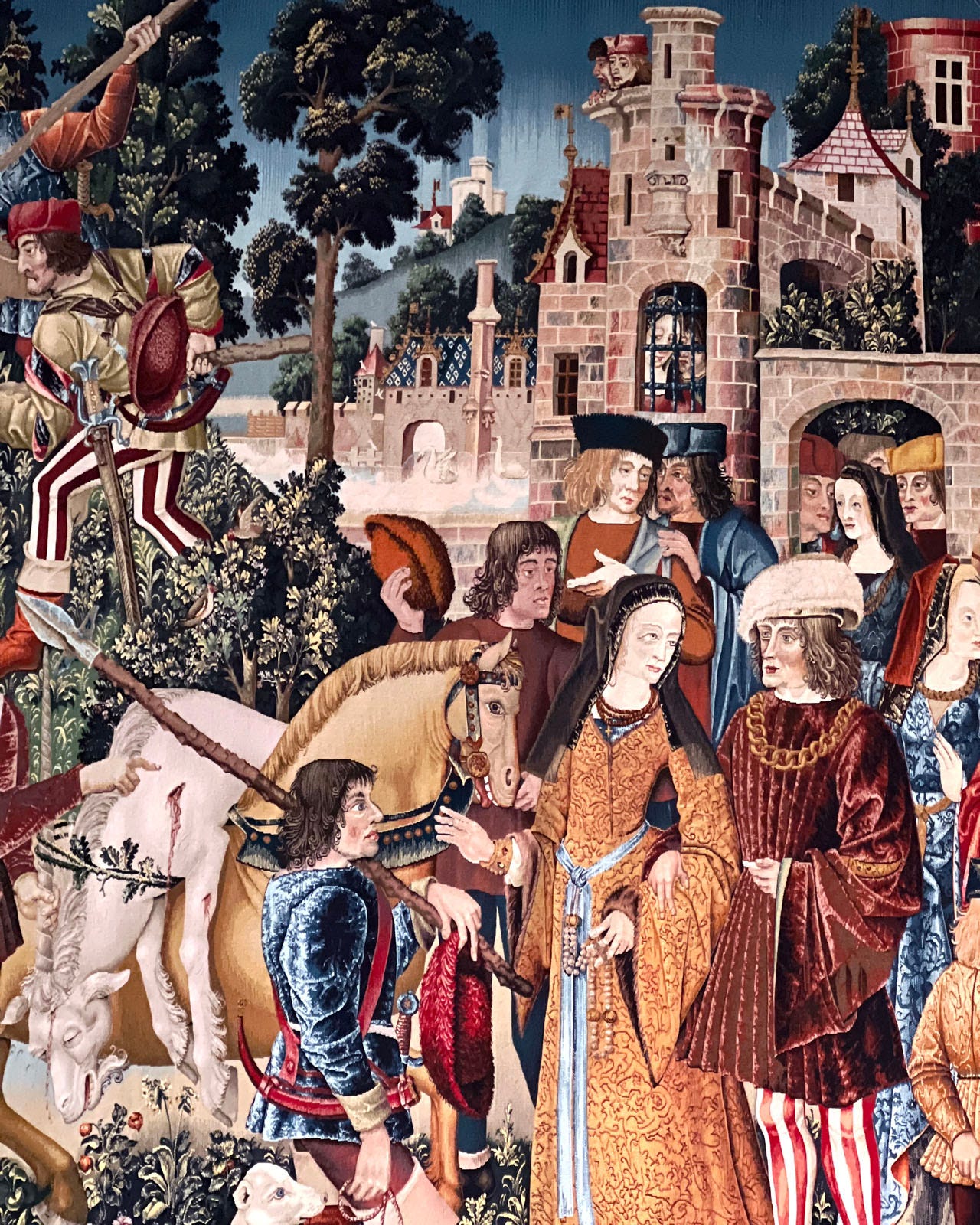
The “Hunt of the Unicorn” tapestries were made in Brussels around 1495-1505, possibly from designs made in Paris. Very little is known about why they were made and for whom, and even the “AE” monogram provides no definitive help.
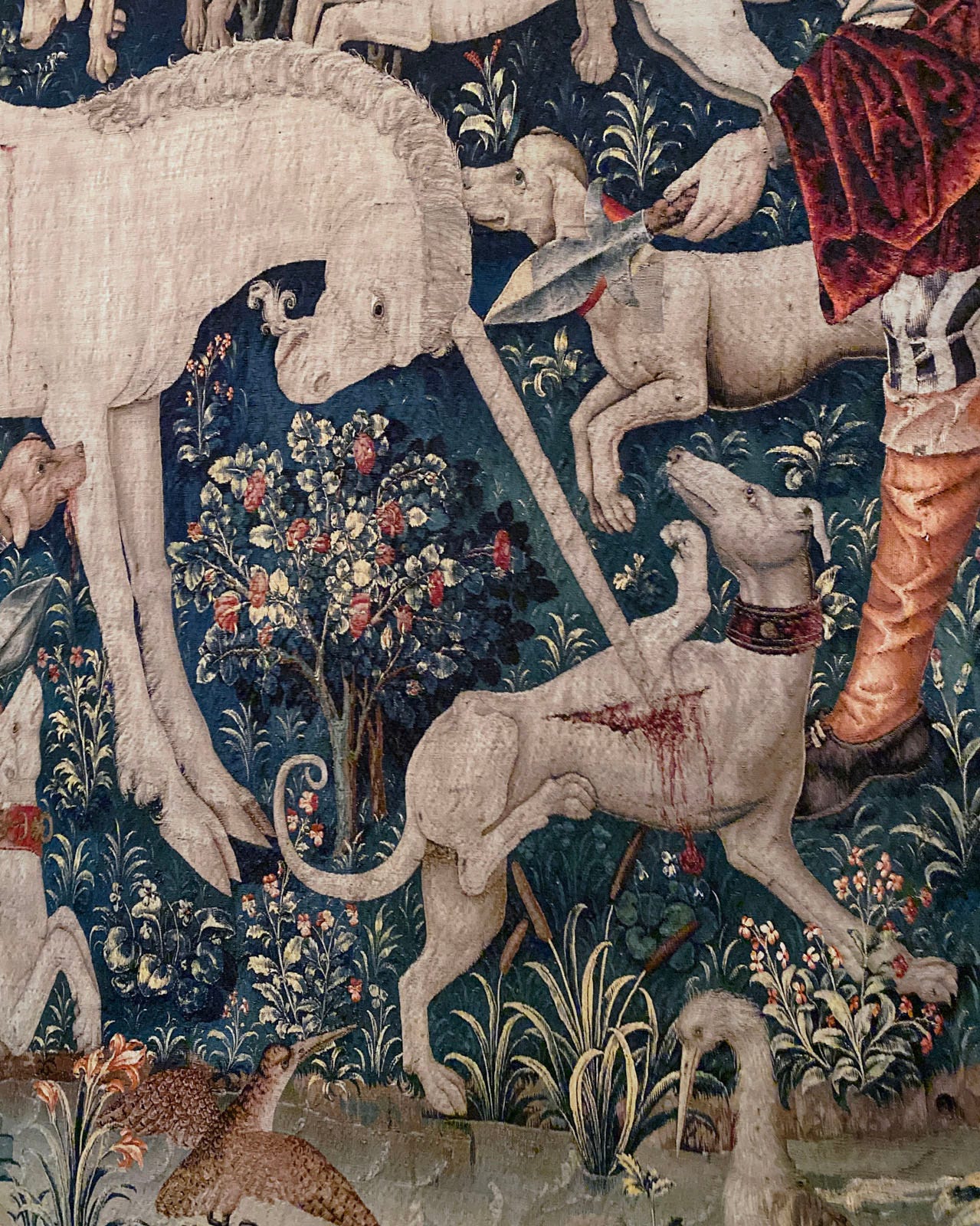
The theme is an expanded version of the single-scene Hunt of the Unicorn art we saw in my unicorn post, and this provides more narrative and texture in terms of its courtly and chivalric interpretation. The expansion also takes the Christological interpretation of the unicorn to another level, enacting a symbolic version of the Passion.
Figures 6-16 below show all of the panels in sequence — some original, some reproductions — as well as a few detail shots of a couple panels. Figure 11 is noteworthy for showing how the people who made the reproductions expanded the fragments of the originals (figure 9) to create a new design.
“The Lady and the Unicorn”
The origins of the “Lady and the Unicorn” tapestries (figures 17-32) are as enigmatic as the Hunt’s, but they seem to have also been designed in Paris around 1500 and also woven in Flanders. The heraldry has recently been interpreted as that of the Le Viste family, suggesting the patron who commissioned them was Antoine II Le Viste (1470–1534), but this is still just highly educated speculation.
These tapestries do not show a narrative but are instead more of a meditation on earthly pleasure and courtly love. Five of the six tapestries represent the five senses — a common motif in cyclical visual art of the late Middle Ages and Renaissance (and one that you can still find even in modern art).
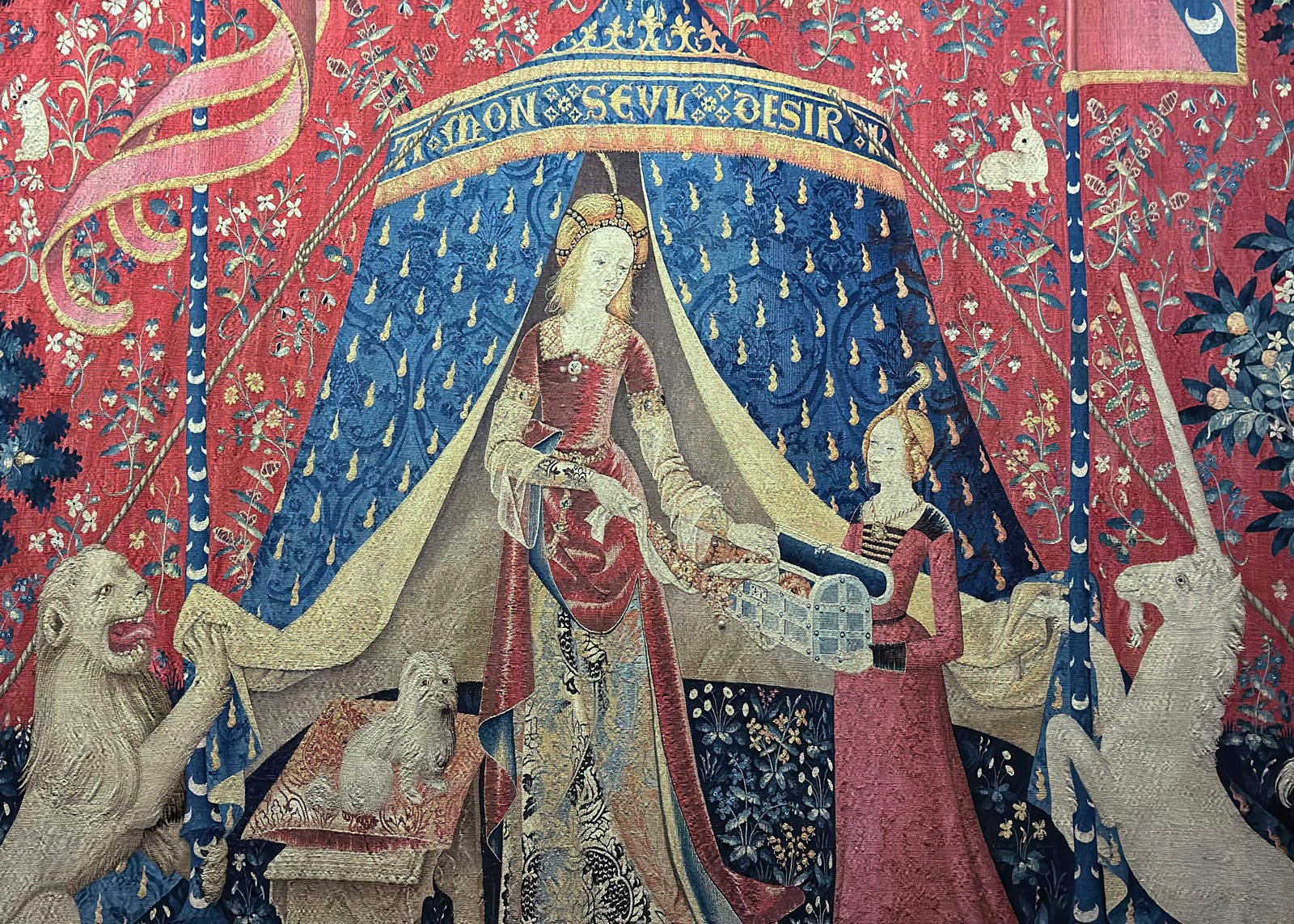
The sixth, inscribed “À mon seul désir,” is traditionally interpreted as representing a “sixth sense” — either reason, understanding, or the renunciation of earthly desire — positioned as the culmination of the cycle.
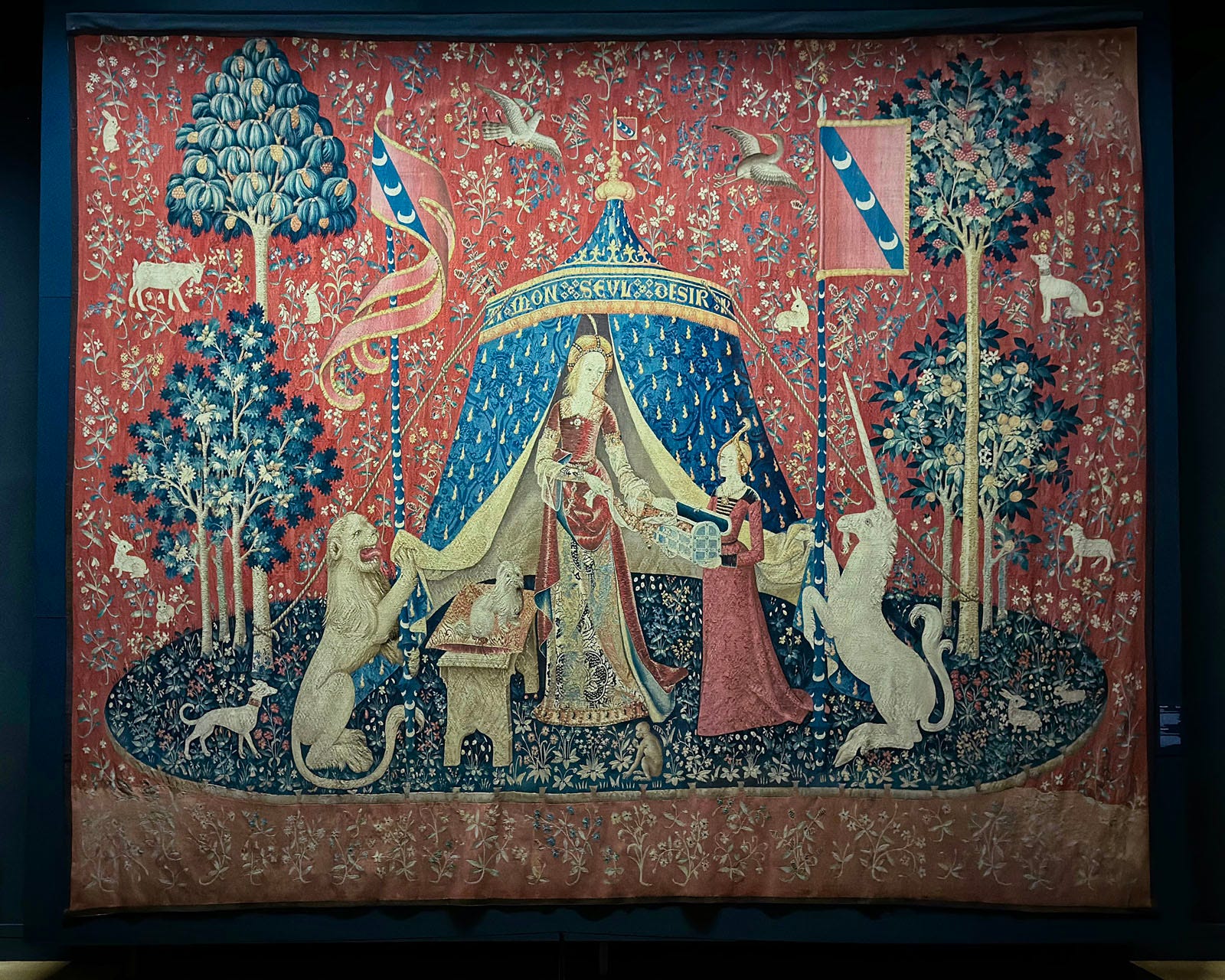
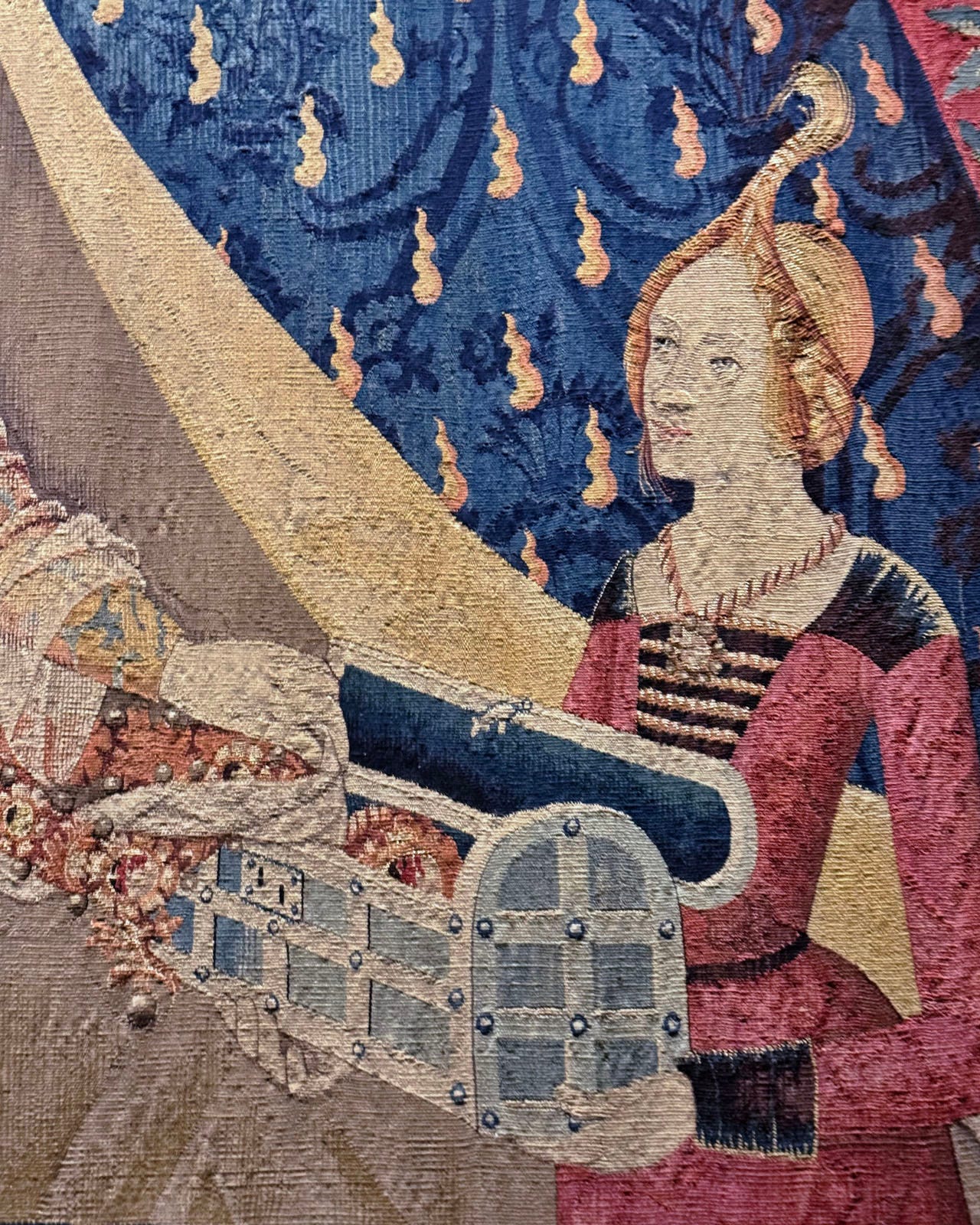
However, it also seems plausible to me that this tapestry functions as a dedication, with the inscription meaning “To my sole desire” rather than “According to my sole desire.” In this reading, the entire cycle becomes an offering to a beloved, quite possibly as a wedding gift from groom to bride. The lady’s gesture of placing jewelry into a casket would then represent not renunciation but dedication — offering her treasures to her beloved.
This interpretation, while just mine, seems entirely consistent with the tapestries’ emphasis on courtly love and their likely function as luxury objects marking important life events. So I present the “To my only desire” tapestry as the first, rather than the last.
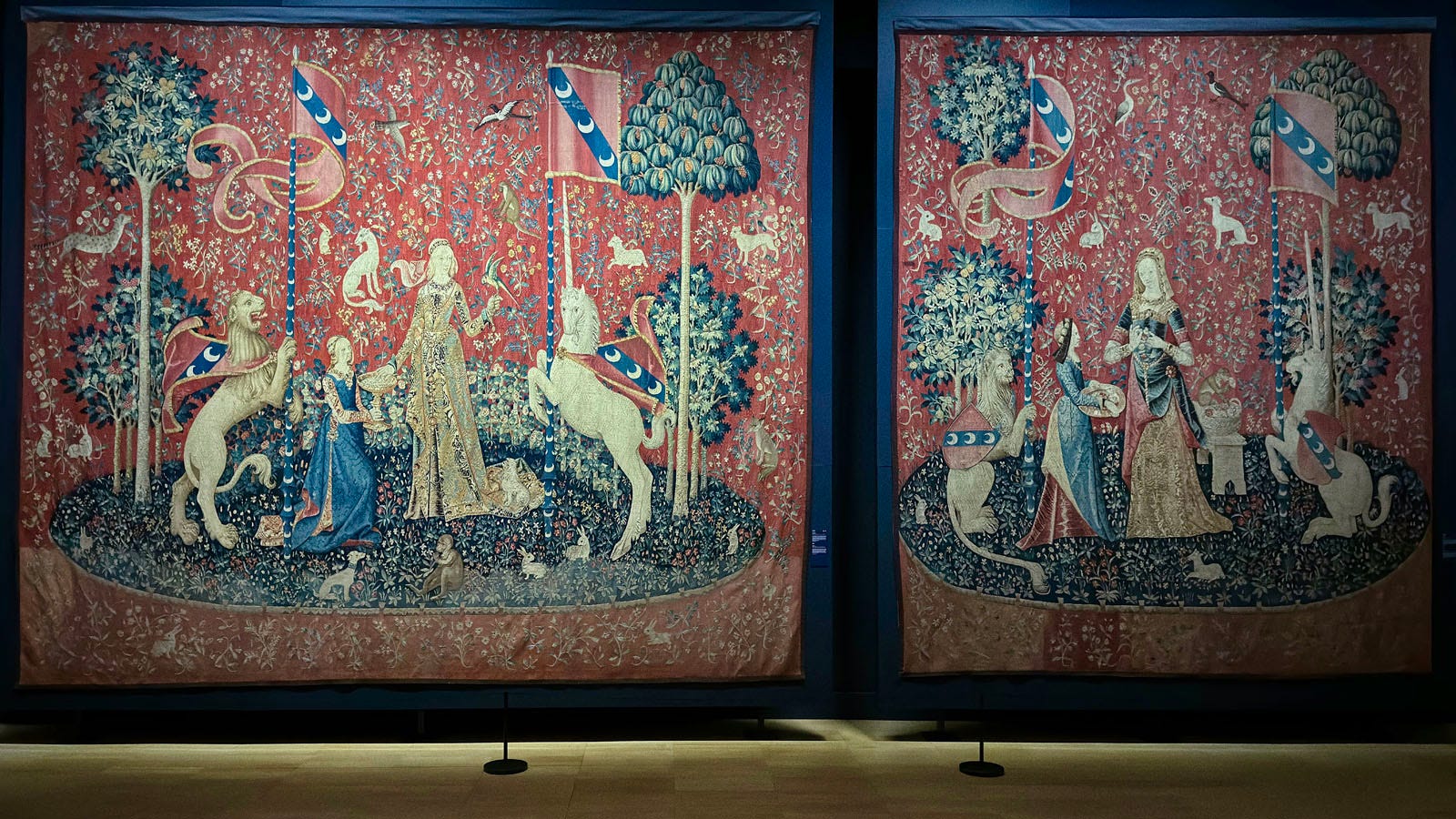
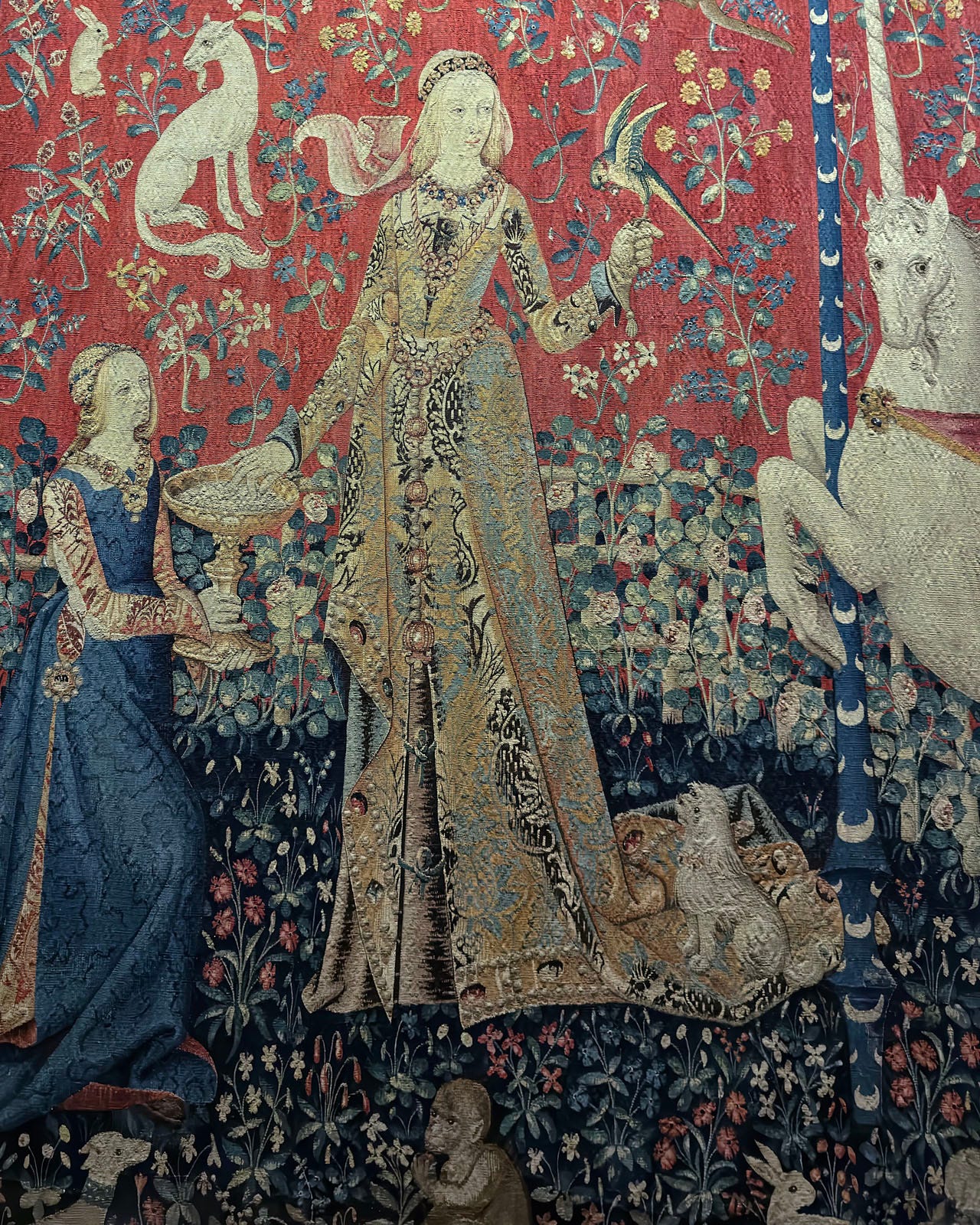
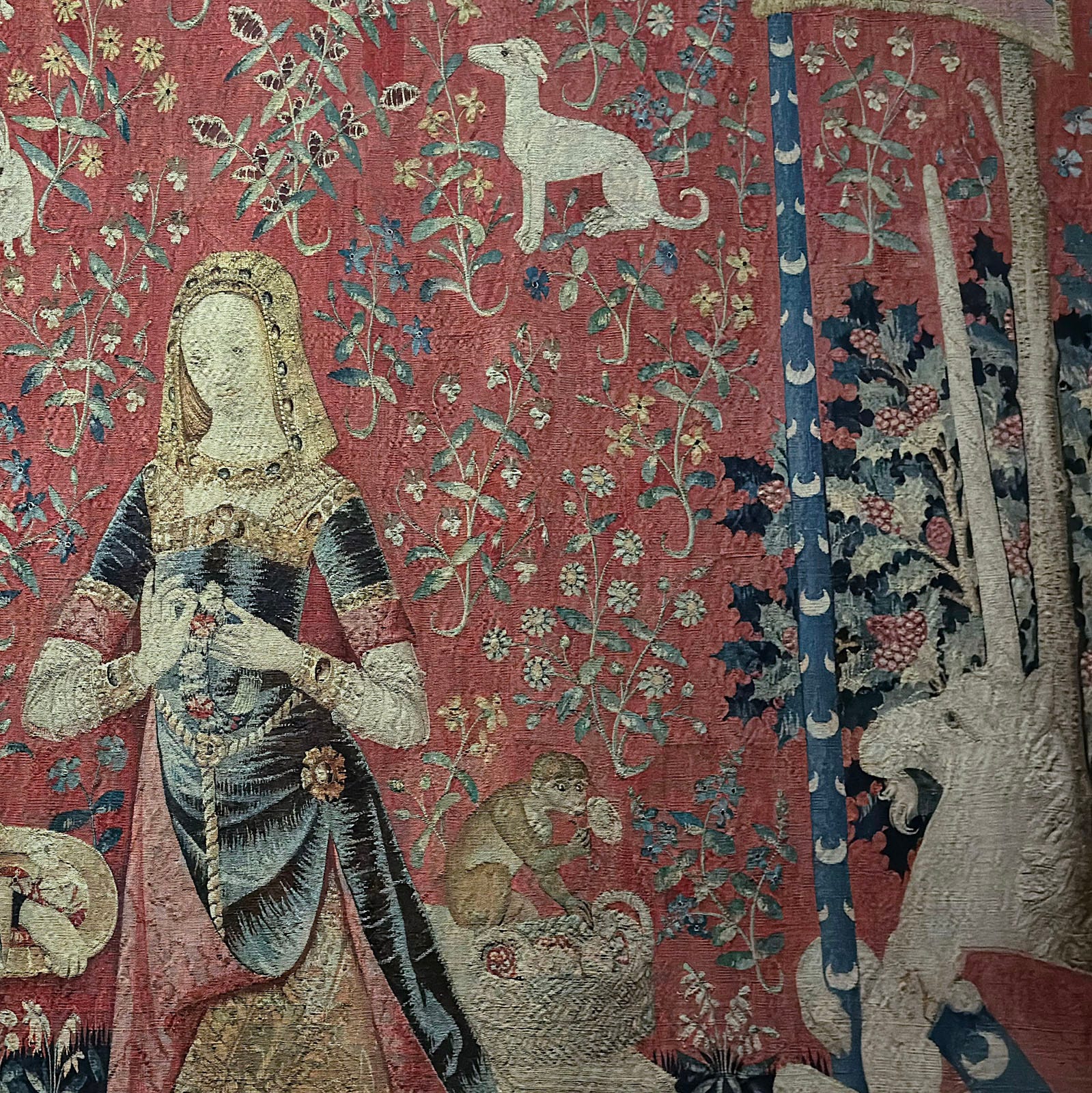
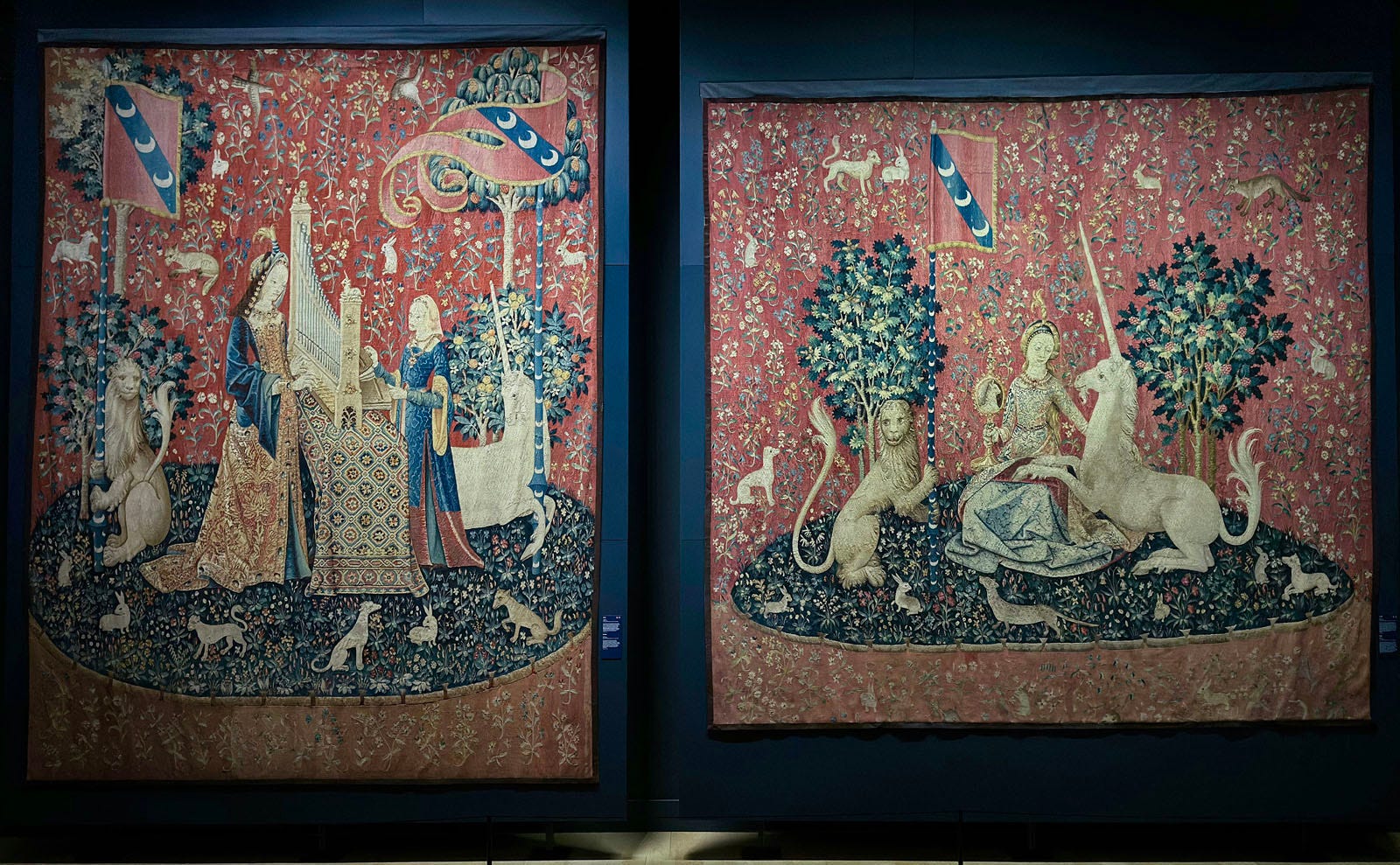
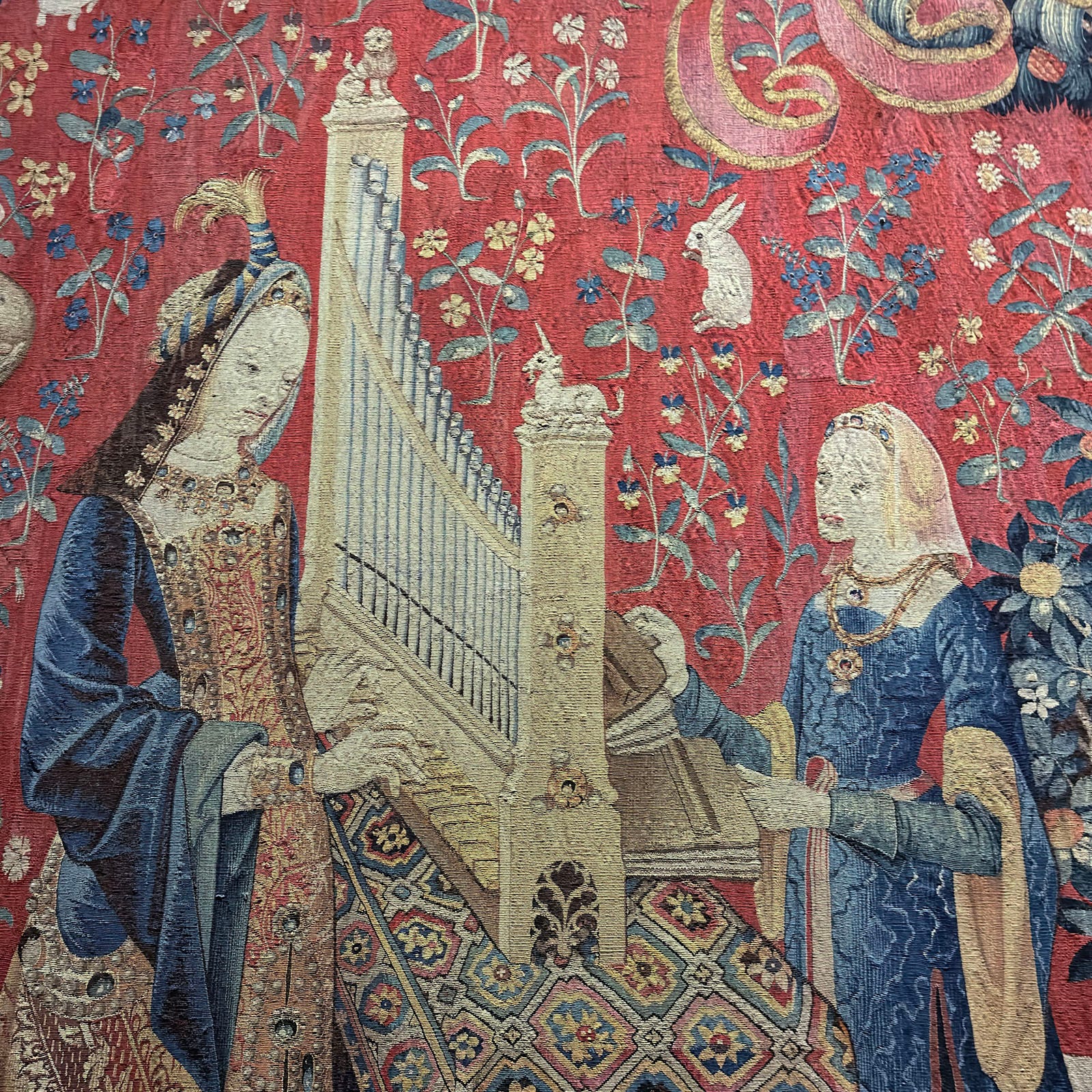
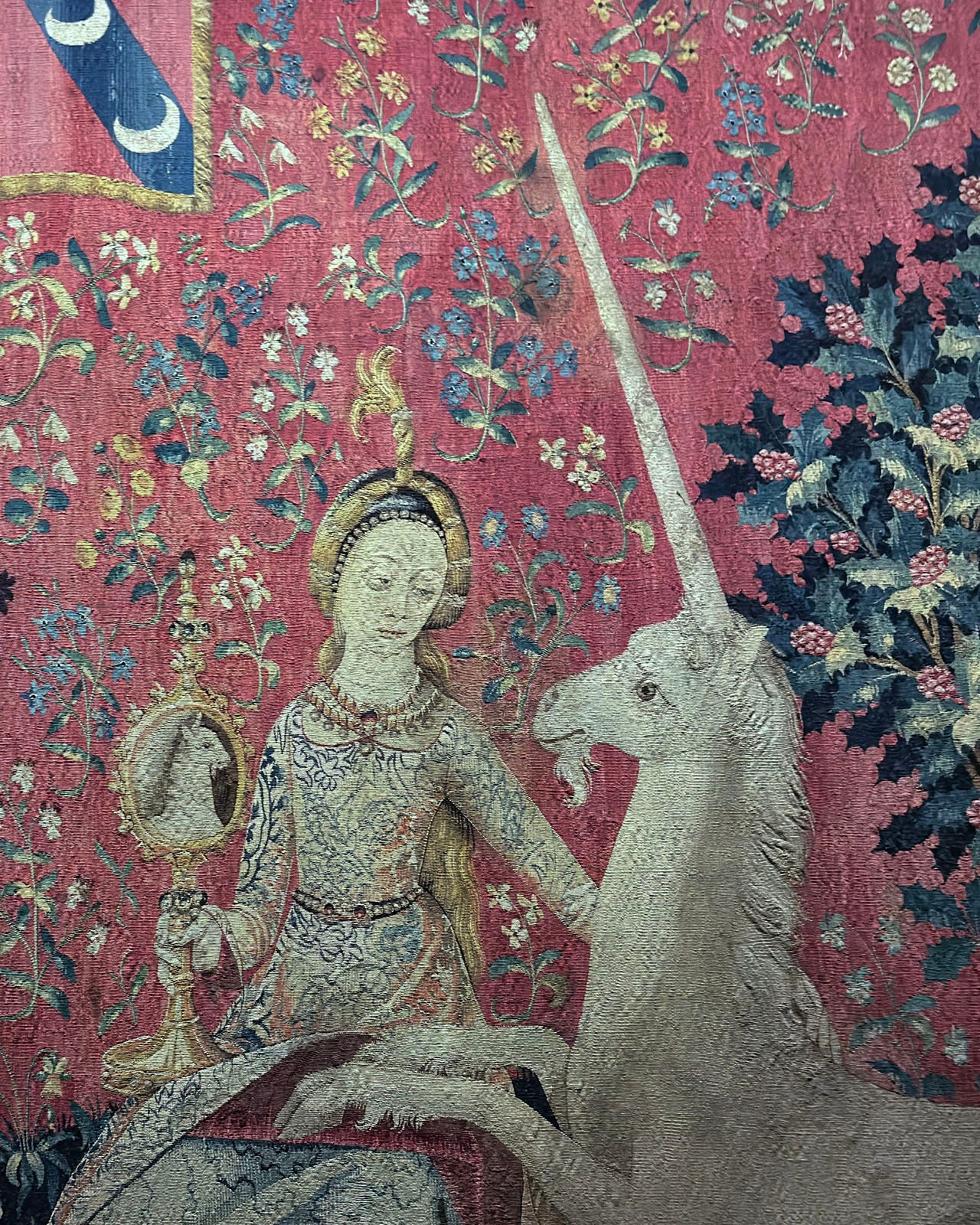
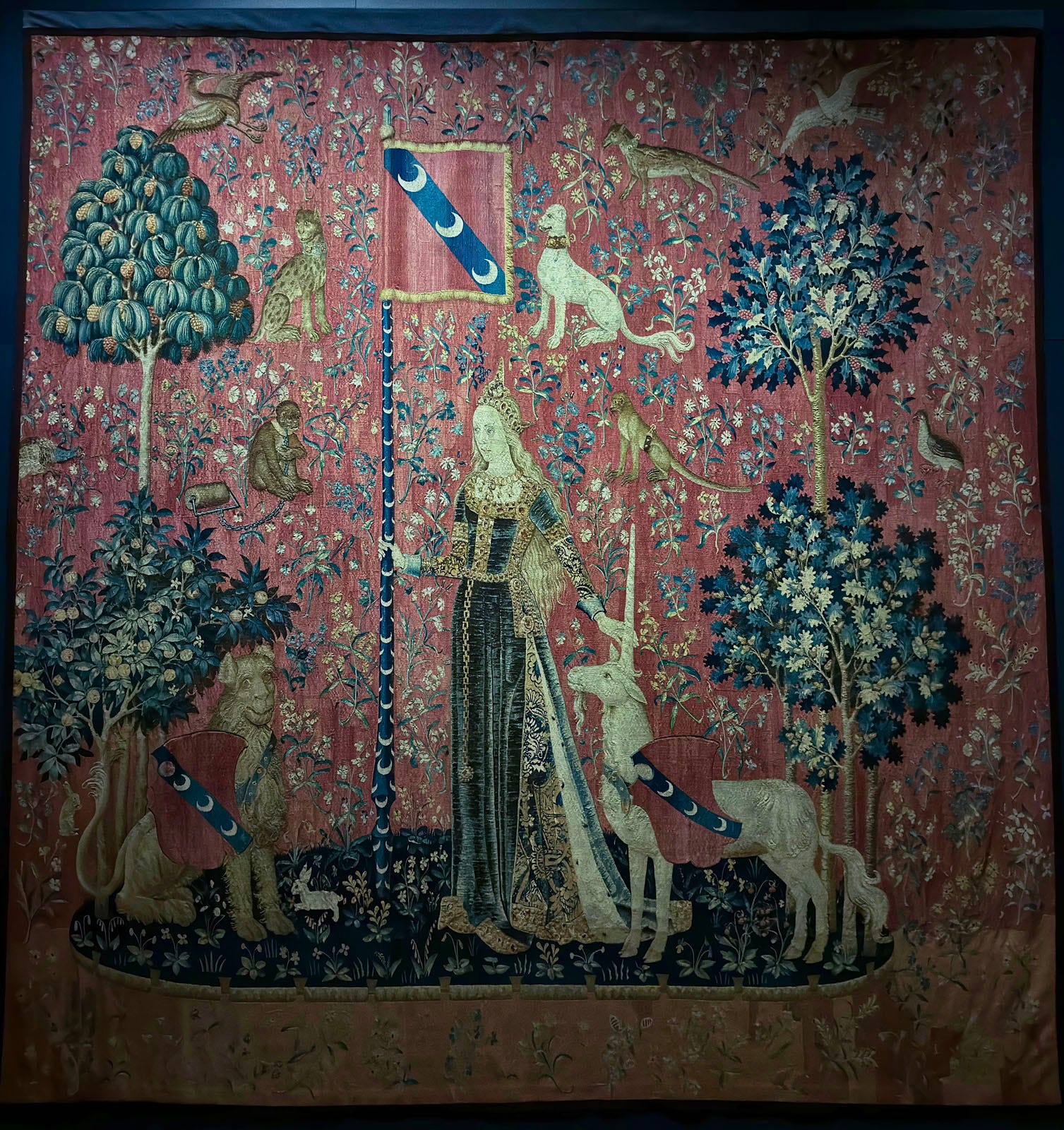
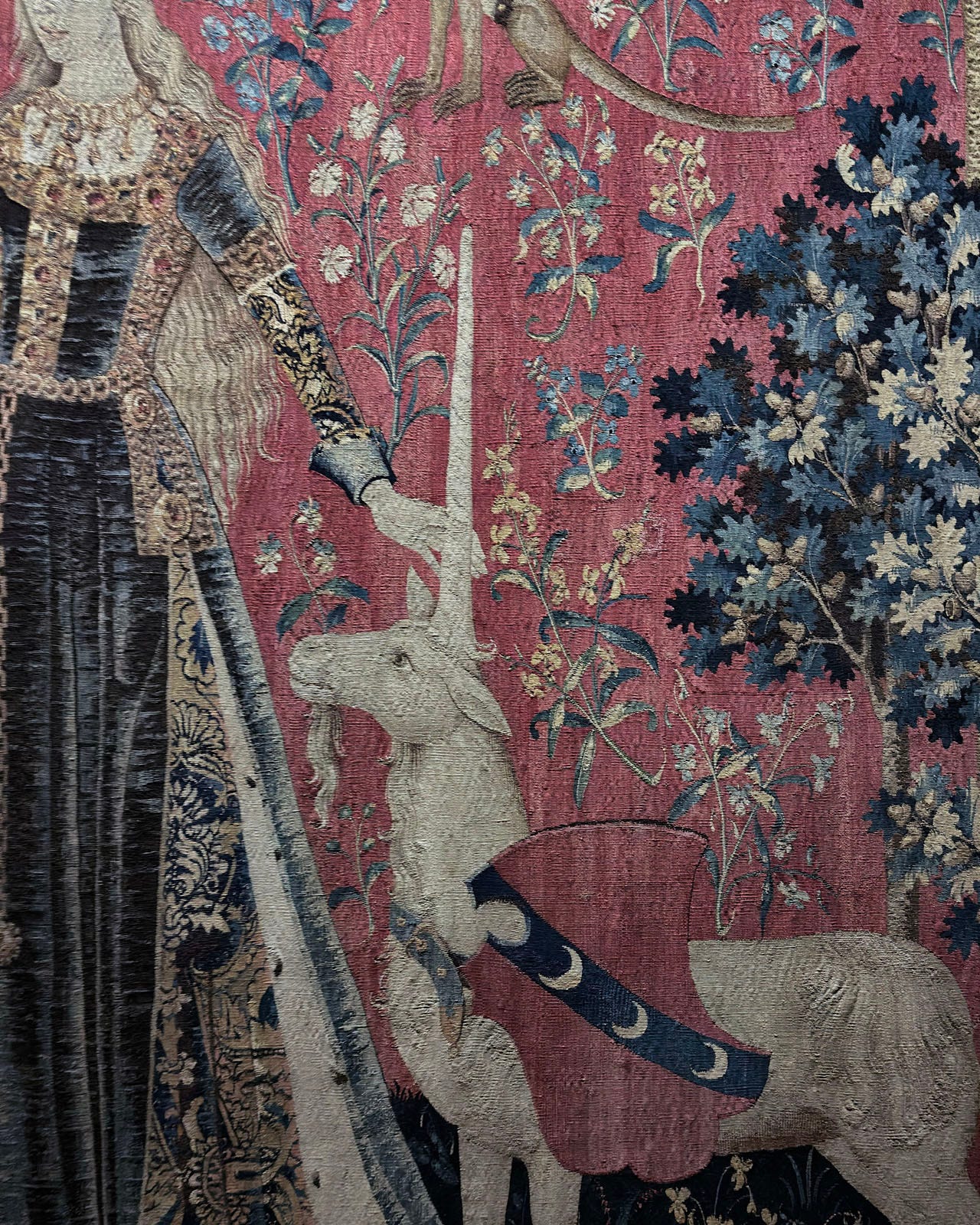
While I greatly enjoy the “Hunt of the Unicorn” tapestries and love its narrative and martial details, it’s “The Lady and the Unicorn” that I find more compelling. There’s something about the scenes floating in millefleur backgrounds, with animals sprinkled about all Eden-like and the Lady enjoying quiet moments with her unicorn and maidens. It creates a fanatical world that I wish I could magically step into.
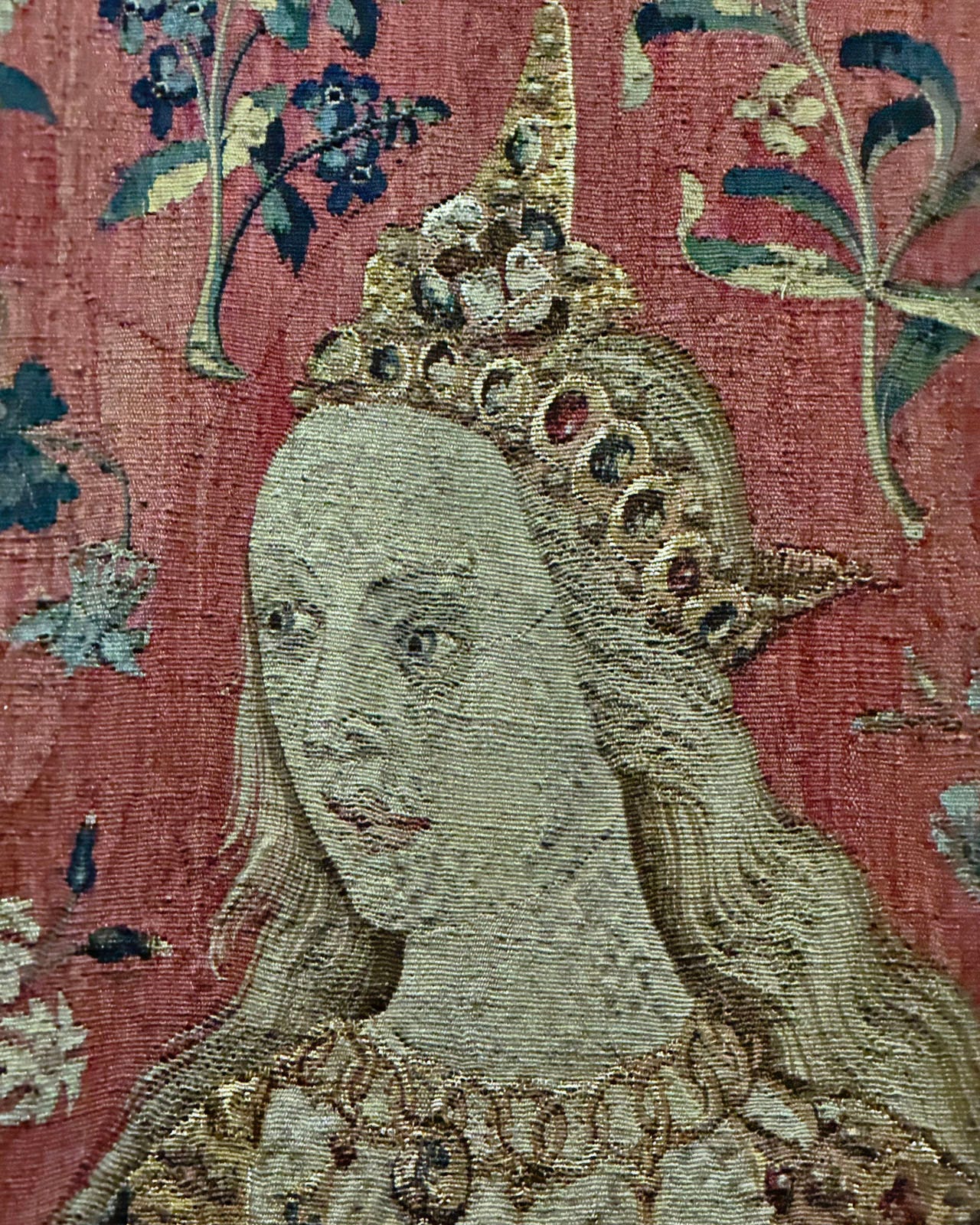
Figures 26-32 show a few of the details I found myself compelled to photograph while spending time with these tapestries, and ten more are shown in the embedded Notes at the bottom.
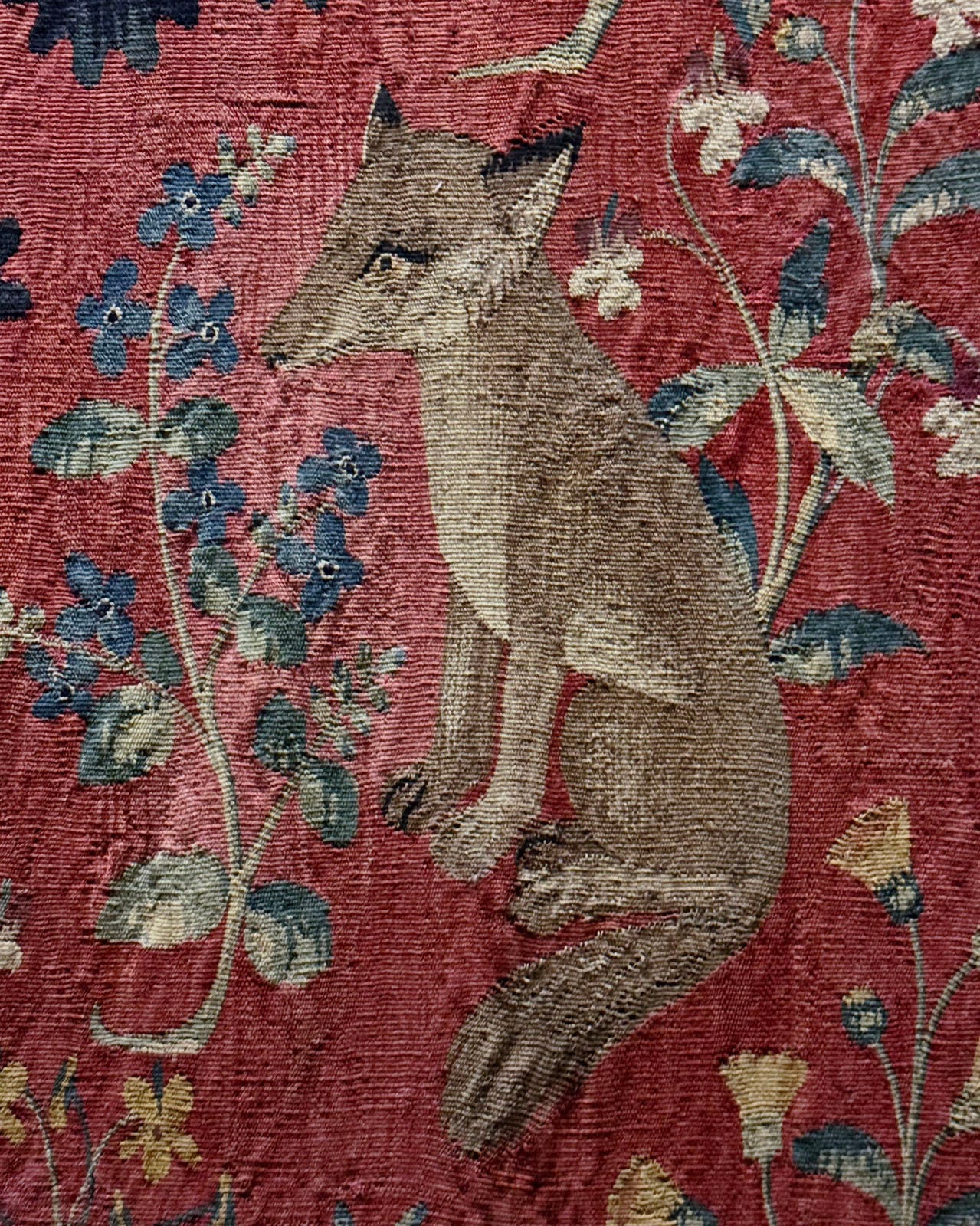
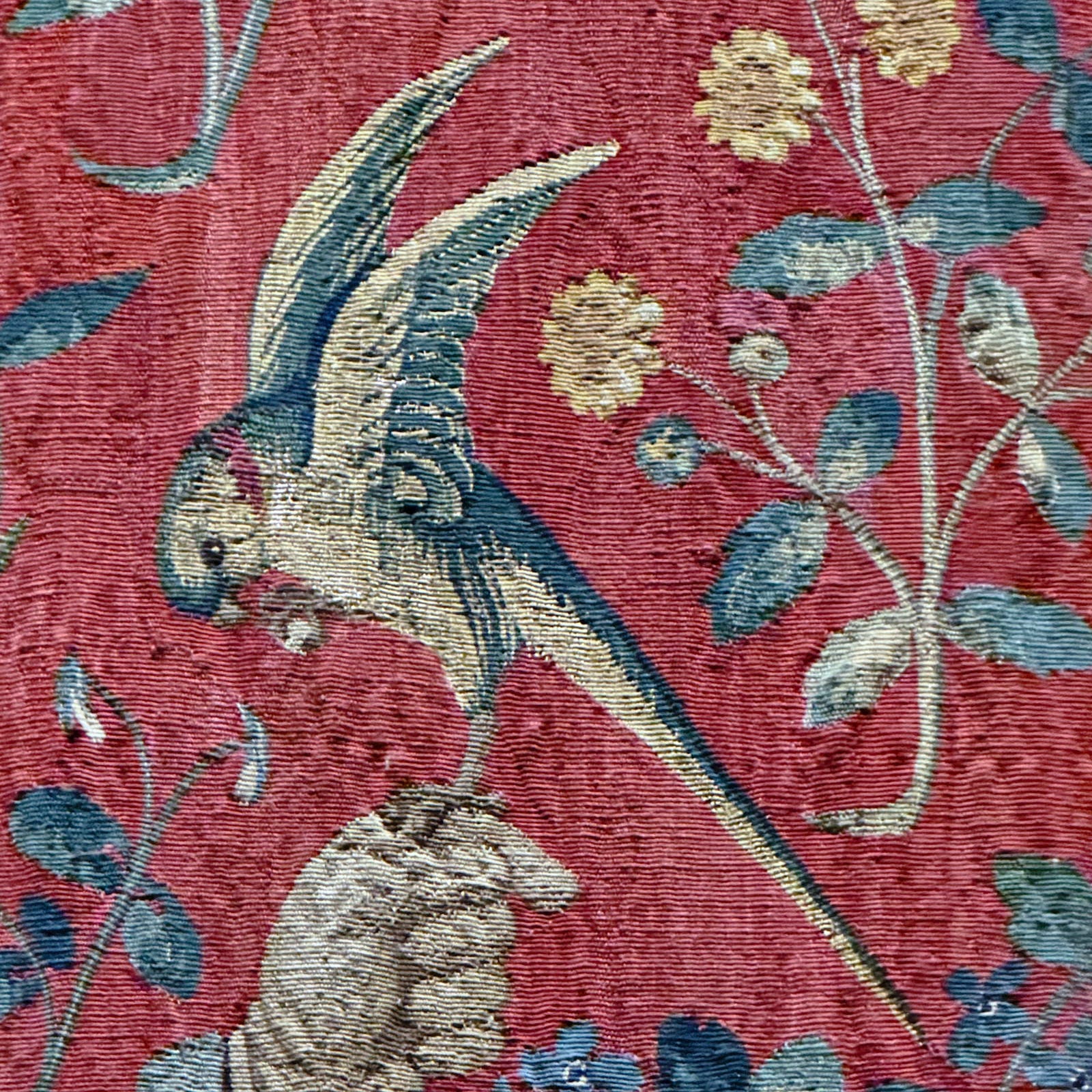
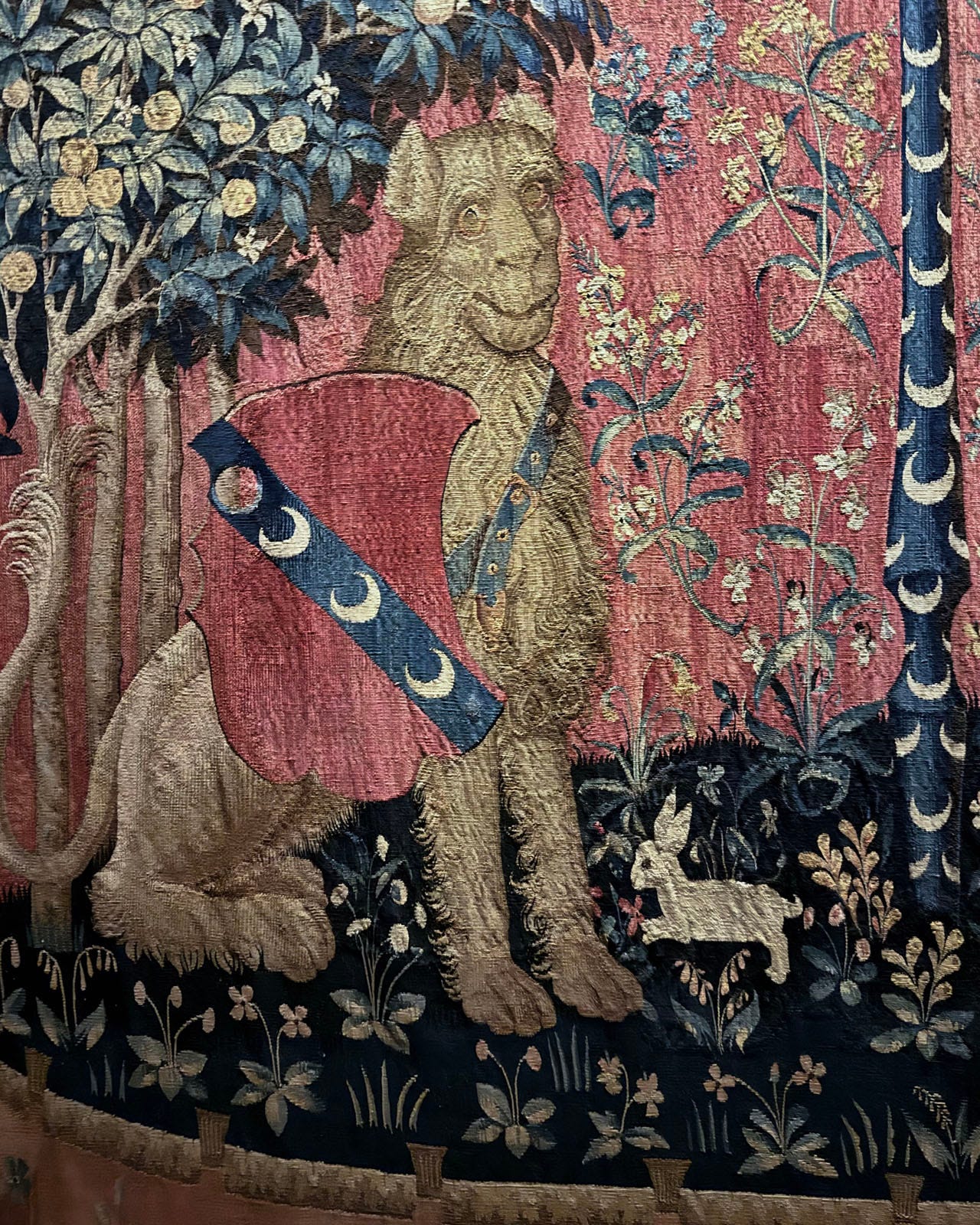
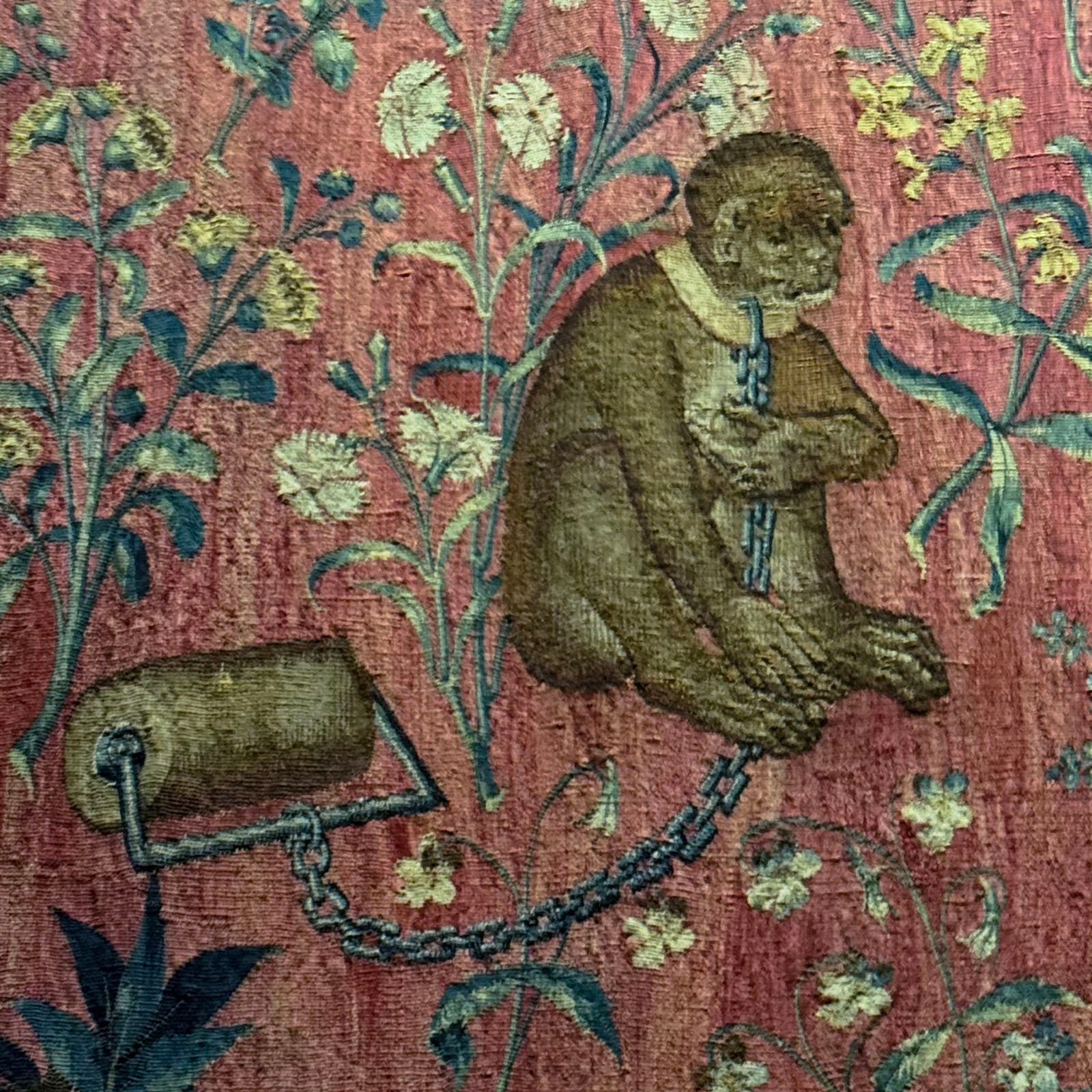
In conclusion, these two cycles represent the pinnacle of medieval tapestry art — combining technical mastery with rich symbolism that continues to captivate viewers centuries later.
** Please like and/or restack this post if you enjoyed it; it helps others to find it! **
In Detail
Here are two Substack Notes showing yet more details from “The Lady and the Unicorn:
Thanks for this. The two sets were exhibited together at the Grand Palais in Paris from late October 1973 to January 1974 and then at the Metropolitan Museum of Art in New York from February to April 1974. https://www.nytimes.com/1974/02/08/archives/met-is-international-host-to-a-gathering-of-unicorns.html?unlocked_article_code=1.UE8.qLaa.lrl0xtMRmYZU&smid=url-share
This brings back fond memories flipping through my parent’s hardcover copy of Margaret B. Freeman’s “The Unicorn Tapestries” as a child. It seemed like a reference book back then which made me convinced that unicorns may not just be fantasy. Thanks for reawakening those moments of childhood wonder.